.jpg)


.jpg)

 English daily published in Bengaluru & Doha

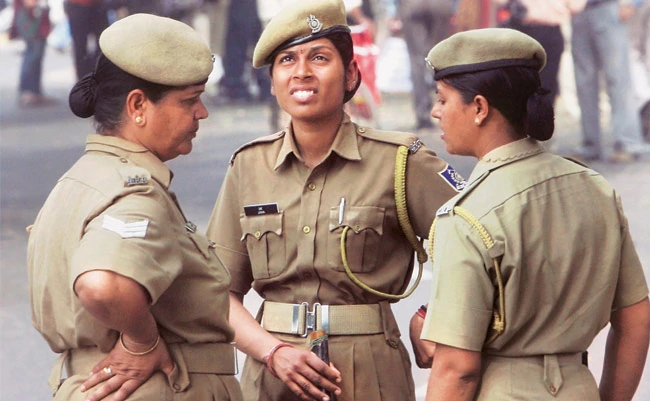
Needed: More Women In The Police Force
Despite several advisories by the Union Government to enhance women’s representation in the police force, women remain highly underrepresented in the police forces across the States. Police being a state subject, the Centre does not have much of a role in the realm except issuing routine advisories. With women’s role in society rising with each day, the need to deploy more women--at least to deal with women and children specific tasks--cannot be overemphasized. Law mandates that cases under POCSO Act, sexual assault and several other major criminal laws be recorded and investigated by female police officers.
Similarly, women police personnel alone must be deployed for arrest or searching a woman. Even juvenile delinquents are best handled by women police officers as they are deemed to be more compassionate and communicative with children. A reply by Union Minister of State for Home Affairs Mr Nityanand Rai in the Rajya Sabha on Wednesday reveals that nationally, overall representation of women in the police force stands at 11.75 per cent. The minister quoted the data collected by Bureau for Police Research and Development (BPD).
Though several states have passed the legislation to accord 33 per cent reservation to women, state-wise figures reveal the representation nowhere reaches that mark. Currently, Ladakh (a Union Territory as of now) accounts for 28.3% women in police force, followed by Andhra Pradesh (21.7%), Chandigarh (21.6%) and Bihar (21.2%). In most other states, the figures hover between 3 per cent to 8 per cent. The recruitment itself being abysmally low currently, the desired goal of police force being comprised of one-third women, is not likely to be achieved before 2050.
Moreover, most women remain clustered at the bottom in the hierarchy and few get to move upward to the officers’ cadre. Given the Bureau statistics, about 11 per cent of total crimes under the Indian Penal Code (IPC) were committed against women and about 5 per cent of total arrested persons were women in 2016. This being the ground situation, it is futile to expect effective compliance of the mandate. In most developing countries, women constitute between 15 to 30 percent of the police forces.
A glance at the serving women personnel would reveal that not many urban women aspire for a role or job in police force. It is still considered infra-dig and disliked for odd time and long hour duties and at times in trouble-torn areas. The ones who get to join the force are mainly drawn from rural areas where a government job is coveted for the purse as well as to challenge the feudal, patriarchal and caste legacies that have been the dominant influences there.
Biases, prejudices, stereotyping, apprehensions, snide remarks and isolation that generally stigmatise women in the larger Indian society stare into the eyes of the potential aspirants in amplified form, when it comes to opting for police forces. With gender roles witnessing a paradigm shift, it is expected that taboos around such jobs would gradually melt to allow women aspire for an equitable role in society

.jpg)
.jpg)
.jpg)
.jpg)
.jpg)