.jpg)


.jpg)

 English daily published in Bengaluru & Doha

US inserts itself into Israel’s war against Iran with strikes on 3 Iranian nuclear sites
DUBAI, United Arab Emirates: The United States inserted itself into Israel’s war against Iran early Sunday by dropping 30,000-pound bombs on an uranium enrichment site buried under a mountain, a risky gambit that aimed to destroy the Islamic Republic’s nuclear program after months of failed diplomacy. The attack prompted fears of a wider regional conflict as Iran lashed out at the U.S. for crossing “a very big red line.”
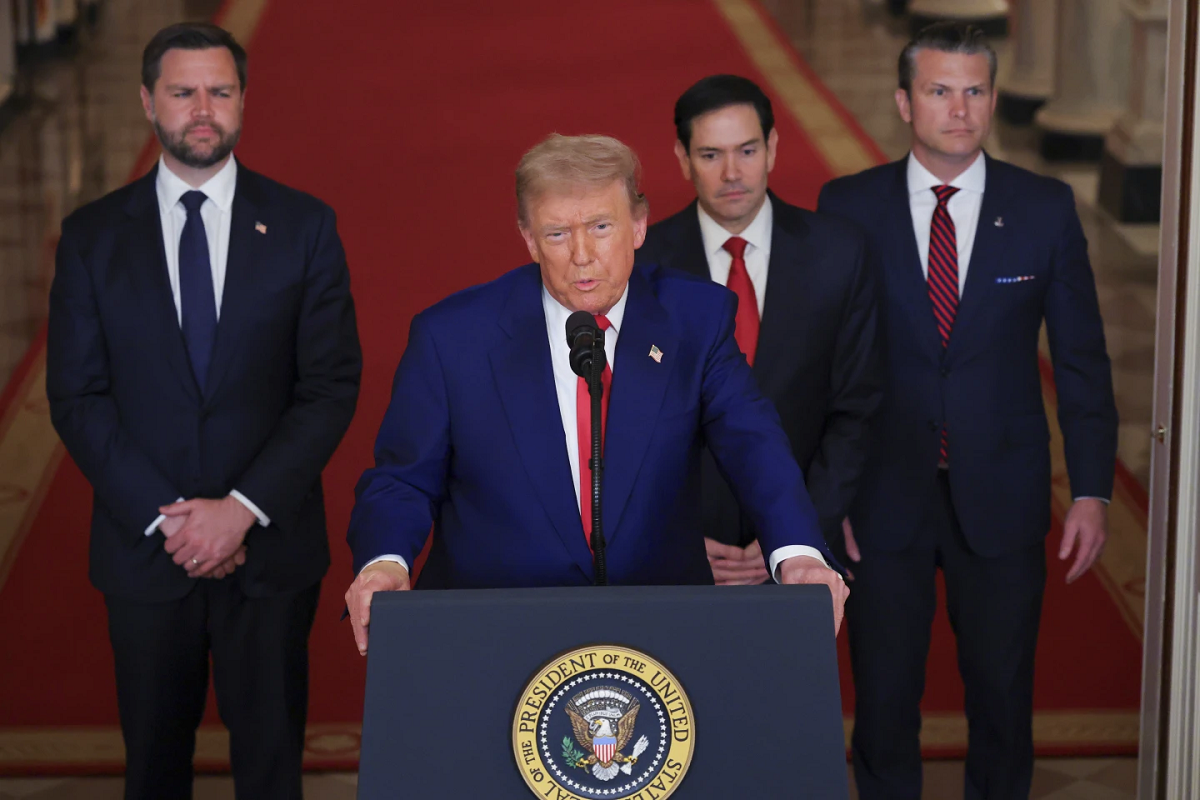
The U.S. also fired dozens of missiles, and President Donald Trump said in a televised address from the White House that the combination of strikes “completely and fully obliterated” three nuclear sites. However, U.S. defense officials said an assessment of the damage wrought by the attack still was ongoing.
Hours later, Iranian Foreign Minister Abbas Araghchi said the time for diplomacy had passed and that his country had the right to defend itself. Araghchi said he would immediate fly to Moscow to coordinate positions with its ally, Russia.
“The warmongering and lawless administration in Washington is solely and fully responsible for the dangerous consequences and far-reaching implications of its act of aggression,” he told reporters in Turkey in the first comments by a high-ranking Iranian official since the strikes. “They crossed a very big red line by attacking nuclear facilities.”
The Atomic Energy Organization of Iran confirmed that attacks took place on the Fordo and Natanz enrichment facilities as well as its Isfahan nuclear site, but it insisted that its nuclear program will not be stopped. Both Iran and the U.N. nuclear watchdog said there were no immediate signs of radioactive contamination around the three locations following the strikes.
Countries around the globe are calling for diplomacy and no further escalation.
It was not clear whether the U.S. would continue attacking Iran alongside its ally Israel, which has been engaged in a war with Iran for nine days. But U.S. Defense Secretary Pete Hegseth said the U.S. does not “seek war” and that the operation would not be “open-ended,” though Trump earlier warned there would be additional strikes if Tehran retaliated against U.S. forces.
“There will either be peace or there will be tragedy for Iran,” said Trump, who acted without congressional authorization.
With the attack, the United States has inserted itself into a war it spent decades trying to avoid because of the dizzyingly high stakes. Success would mean ending Iran’s nuclear ambitions once and for all and eliminating the last significant threat to Israel’s security. But failure — or overreach — could plunge the U.S. into the vortex of another long and unpredictable conflict in the Middle East.
For Israeli Prime Minister Benjamin Netanyahu, this is the culmination of a decadeslong campaign to get the U.S. to strike Israel’s chief regional rival and its disputed nuclear program. For Iran’s supreme leader, the 86-year-old Ayatollah Ali Khamenei, it could mark the end of a similarly ambitious campaign to transform the Islamic Republic into a regional power and counterweight to the West.
Hours after the U.S. strikes, Iran’s paramilitary Revolutionary Guard said it launched a barrage of 40 missiles at Israel, including its Khorramshahr-4, which can carry multiple warheads. Israeli authorities reported that more than 80 people suffered mostly minor injuries, though one multistory building in Tel Aviv was significantly damaged, with its entire facade torn away to expose the apartments inside. Houses across the street were almost completely destroyed.
Following the Iranian barrage, Israel’s military said it had “swiftly neutralized” the Iranian missile launchers that had fired, and that it had begun a series of strikes toward military targets in western Iran.
The US helped Israel strike Iran’s toughest nuclear site
Iran has maintained that its nuclear program is for peaceful purposes only, and U.S. intelligence agencies have assessed that Tehran is not actively pursuing a bomb. However, Trump and Israeli leaders have argued that Iran could quickly assemble a nuclear weapon, making it an imminent threat.
The decision to directly involve the U.S. in the war comes after more than a week of strikes by Israel that significantly degraded Iran’s air defenses and offensive missile capabilities, and damaged its nuclear enrichment facilities.
But U.S. and Israeli officials have said the 30,000-pound (13,500-kilogram) bunker-buster bomb offered the best chance of destroying sites program buried deep underground — and the U.S. is the only military that has both the munitions and the planes to drop them.
Fourteen of the bombs were used on two nuclear sites, including Fordo, according to Air Force Gen. Dan Caine, chairman of the Joint Chiefs of Staff. In all he said, 75 precision-guided weapons were used, including missiles fired from a submarine.
He said the final damage assessment would take time, but that all three sites “sustained extremely severe damage and destruction.” (AP)