.jpg)


.jpg)

 English daily published in Bengaluru & Doha

Bengaluru's green light to 'smarter' commutes
In a collaborative event on Thursday, Tummoc and Namma Yatri debuted innovative features for seamless metro, bus, & last-mile travel
Bengaluru: I used to switch between three apps just to plan a single commute," says Shruthi Rao, a daily commuter from Banashankari. "Now with one app, I can check metro timings, book an auto, and even track my carbon savings. It feels like Bengaluru’s finally catching up to its tech reputation." For thousands of Bengalureans like Shruthi, public transport is about to become more connected, convenient, and climatefriendly.
On July 10, at a collaborative event that brought together government, industry, and civic stakeholders, the winners of the Enroute: A Mobility-as-a-Service (MaaS) Challenge — Tummoc and Namma Yatri unveiled new app features designed to revolutionise how residents move through the city.
The initiative is led by Mercedes-Benz Research and Development India (MBRDI), WRI India, and Villgro, and aims to simplify multimodal journeys — integrating metro, bus, and last-mile options like autos into one digital ecosystem.
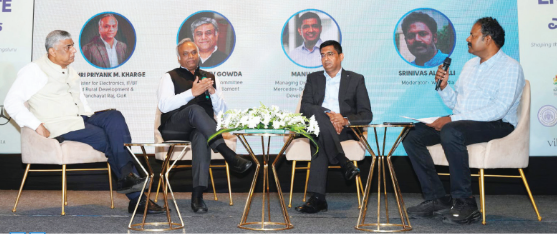
Innovation driven by open data Officially launching the new features, Priyank M. Kharge, Minister for Electronics, IT, BT, and Rural Development & Panchayat Raj, Government of Karnataka, said: "Bengaluru aims for a 70% public transport share by 2030. To achieve this, infrastructure is not enough — open data and digital integration are key.
Enroute is a transformative step that empowers local startups to address our city’s unique mobility challenges." The apps rely on General Transit Feed Specification (GTFS) data openly provided by BMTC and BMRCL, making it the first city-wide attempt at an end-to-end digital public transport solution in Bengaluru.
Through these platforms, commuters can now plan, book, and track their metro, bus, and auto journeys in real time — a potential game-changer for a city adding hundreds of new residents every day.
Future-forward transport ecosystem The Enroute MaaS Challenge demonstrates how Bengaluru — long regarded as India’s startup capital — is applying its tech prowess to urban infrastructure.
By bringing government data into the public domain and supporting startup innovation, the city is making strides toward a cleaner, less congested, and more efficient public transport network.
As private vehicle growth continues to clog roads and pollute the air, enabling app-based multimodal integration becomes not just an innovation — but a necessity.




.jpg)
