.jpg)


.jpg)

 English daily published in Bengaluru & Doha

Kothanur Dinne: The bleak reality masked in a glossy exterior
This Bengaluru suburb is failing its most vulnerable residents with poor sanitation, administrative neglect, and the struggle for access to basic government welfare
Bengaluru: Kothanur Dinne (under ward 194), is a residential sub-locality of JP Nagar in Bengaluru South. The locality boasts robust infrastructure, with the Kothanur Dinne Main Road as its primary artery. The connectivity is a key highlight due to its proximity to the Yelachenahalli Metro Station on the Green Line.
Some notable neighbouring localities include Gottigere, Arekere, Hulimavu, and Konanakunte. The locality offers residents convenient access to essential social amenities, including schools, healthcare facilities and major employment hubs like Electronic City and the Jigani industrial area.
Kothanur Dinne may be developing quickly, but most residents still grapple with unhygienic food practices, irregular waste manage ment, and limited access to welfare schemes.
Is it really safe to eat?
The main roads and footpaths here are crowded with small eateries, and most of them are informal setups. While affordable food draws steady crowds, these stalls raise serious concerns about hygiene and safety. Most lack basic sanitation protocols.
A young girl selling bright red chicken kebabs admitted, “We cut the meat in the next shop and bring it here to fry and sell. It’s Rs 40 for 100 grams.” Such practices, in the busy localities, pose significant health risks.
Mounting menace
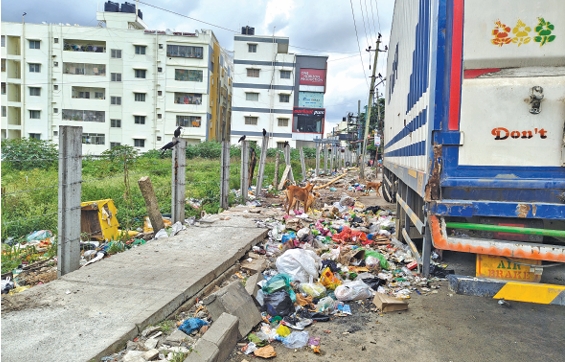
Equally troubling is the state of garbage collection. “The BBMP tippers do come, but not regularly, sometimes only thrice a week,” said Thayyama, a resident who moved to Bengaluru two years ago. News Trail observed numerous garbage black spots in the vicinity, the most alarming one near Kothanur Cross Road, close to a reputed educational institution.
The stretch is littered with domestic waste, construction debris, and even abandoned cars, a sight well known to locals who feel civic neglect is the norm.
Broken promises
For residents like Thayyama, who has four children, struggles extend beyond cleanliness. She explained how her family’s ration card was cancelled, and repeated attempts to get a new one were met with excuses. “We don’t want money, at least give us rice to live on,” she said in frustration.
Officials reportedly dismiss applications, claiming, “It’s not the season to create new ones.” The area’s contrasting picture, with modern development on one side and neglected communities on the other, reflects the governance gap. Basic facilities and welfare schemes are often out of reach for the needy.
Adding to civic woes, the locality faces heavy traffic daily and the constant movement of commuters, coupled with stray cattle on the busy stretch, only worsens the congestion and safety risks. Kothanur Dinne’s growth story reveals an urgent need for stronger civic management and better delivery of government schemes to ensure no resident is left behind.
.jpg)




.jpg)