.jpg)


.jpg)

 English daily published in Bengaluru & Doha

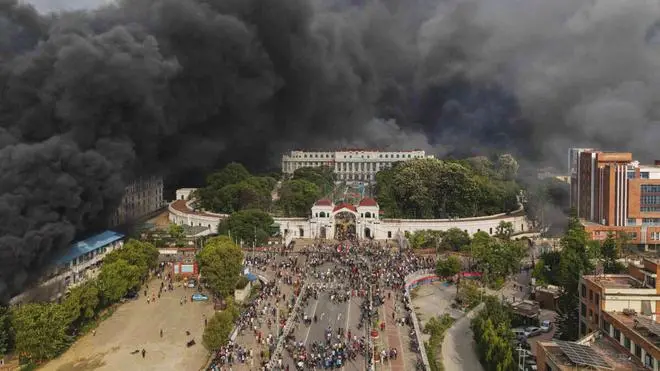
India’s troubled neighbourhood has a new entrant, Nepal
Tth Nepal plunging into chaos in the face of massive anti-government protests, India’s neighbourhood is indeed in turmoil which is certainly not a healthy sign. What is happening in Nepal comes on the trail of what happened in Sri Lanka and Bangladesh.
There has been a series of incidents of instability in countries in the neighbourhood, which have led to the collapse of regimes and their leaders fleeing. Various ambassadors and diplomats suggested that while India should let domestic processes play out in Nepal, New Delhi should carefully watch the unfolding situation.
In Sri Lanka’s case, there has been stability after the 2022 protests, and Bangladesh is supposedly moving towards an election. Myanmar continues to be an unstable country, but arguably, also moving towards election. But then, there are the Taliban sitting in Afghanistan, as well as the perpetual uncertainties in Pakistan.
So, overall, it is a difficult neighbourhood for India. As unrest continues in Nepal, Uttar Pradesh’s border districts saw empty markets, with residents grappling with cancelled travel plans and severed family contacts across the frontier and many expressing concern over the disruption of their daily lives, and livelihoods.
Tourism and medical travel have collapsed. Many families who regularly visit Nepal for eye treatment or leisure trips have cancelled plans, hurting hotels and tour operators. While the scale of the impact varied, locals across districts said the unrest had upended their routine connections with Nepal, with fears that prolonged disruption could cause long-term damage to trade and livelihoods on both sides of the border.
India continues to hold its position as Nepal’s largest trading partner, according to the latest Nepal Trade Statistics released by the Department of Customs. Nepal exports a variety of goods to India, including hydroelectric power, resin, agricultural produce, yarn, pashmina shawls, hide and skins, handicrafts, as well as silver and gold jewellery.
On the other hand, Nepal’s imports from India primarily consist of petroleum products, chemical fertilizers, salt, sugar, rice, vehicles, copper, and cotton, among other items. India is monitoring the situation to safeguard bilateral trade, having exported goods worth $7.32 billion in FY25.
In FY25, it exported goods worth $7.32 billion to Kathmandu, while imports into India totalled $1.2 billion, resulting in a substantial trade surplus for India. Any disruption in transport routes, customs operations, or cross-border logistics could delay shipments, impacting both Indian exporters and Nepali consumers.
Indian goods are transported to Nepal almost entirely via road, as the Himalayan nation is landlocked and has no seaports. For India, which shares a 1,751-km unfenced border with Nepal, the unrest carries immediate security, economic and humanitarian implications that are still unfolding.
The timing of the protests in Nepal too, has invited speculation since Oli had just returned from a visit to China for the Shanghai Cooperation Organisation Summit and was scheduled to visit India. Analysts opined that Nepal is geopolitically significant for India as a buffer with China.
If the crisis worsens, India could face sustained trade disruption, larger refugee flows and an uptick in cross-border criminal activity.

.jpg)
.jpg)
.jpg)
.jpg)
.jpg)