.jpg)


.jpg)

 English daily published in Bengaluru & Doha

Nepal’s ordeal by fire
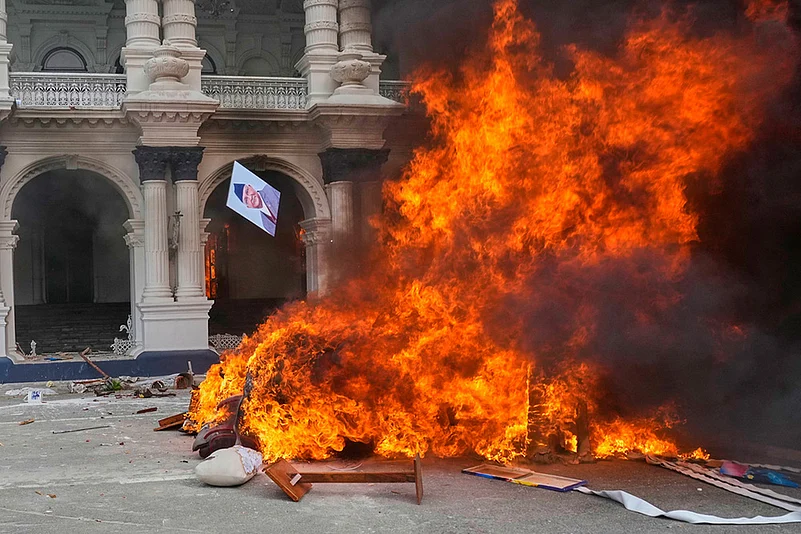
Nepal was a ticking time bomb which exploded on Tuesday (September 9). People’s fury against corruption, the dysfunctional government, indifferent authorities, rampant nepotism and glaring economic inequalities only needed a trigger. The ban on 26 social media platforms by the government came in handy for the youth to launch a no-holds-barred assault on anything bearing even a remote semblance of power and authority. They did not spare even the National Parliament building and Singha Durbar, the seat of the monarchy for centuries, the historic landmark in capital Kathmandu. Ministerial houses have been ransacked and set afire and reigning ministers were chased and thrashed in the streets.
Not to be missed is the small accident in which a 11-year old girl was flung away after being hit by the speeding car of Koshi province minister Ram Bahadur Magar in Lalitpur a couple of days prior to the social media ban. The insensitive remark on the mishap being ‘a normal accident’ by prime minister KP Sharma Oli set media platforms aflame. The video footage of the mishap and the remark, highlighted the callousness that has crept into the system which also ensures impunity to the political elite. The stories of little eldorados built in the Himalayan heights by kids of the corrupt elite have further exacerbated the sense of dispossession among the masses.
Open flaunting of luxurious lifestyles had already sharpened and heightened the sense of deprivation among the masses who were migrating to either India or to destinations in the Gulf to take up small jobs thereby keeping alive the nation’s forex reserves. The scenes of vandalism that the capital of the Himalayan nation has witnessed, resonate with what happened in Dhaka a year ago and was experienced by Colombo two years ago and Jakarta recently. Needless to say, all three nations are democracies and have replaced governments regularly.
Yet nothing could deter the pent-up anger of the masses exploding onto the streets and demonstrating to the world how despondent the youth had become with a sterile future to look at. These movements have erupted in diverse corners of South and South-east Asia but share a central core. They endorse Generation Z’s refusal to sit back and accept the economic stagnation with resignation. They are spontaneous and exuberant. But at the same time, they are decentralised, largely leaderless and non-ideological. They demonstrate discontent, but show complete lack of alternative vision for rectification of the systemic flaws.
They demand accountability but are bereft of a cogent vision of what has to come after. This is where they seem vulnerable to hijacking of their cause by right-wing forces. And Nepal has been a fertile ground for such forces that made this investment to ward off the tiny state’s tilt towards China. Western embassies have been funding the NGOs for decades to keep the leftists at bay but with little success. It is the internal corruption of the two Maoist parties and their betrayal of hope that have now cleared the path for the drift of the youth towards the right. Not only the Leftists, it is the collective failure of the Nepalese political elite who have squandered the revolutionary heritage they gathered during the anti-monarchy agitation. It is for Nepalese politicians, activists and people to see if that spirit can be reignited and the vision restored.

.jpg)
.jpg)
.jpg)
.jpg)
.jpg)