.jpg)


.jpg)

 English daily published in Bengaluru & Doha

The trust factor must return to Tata Trusts
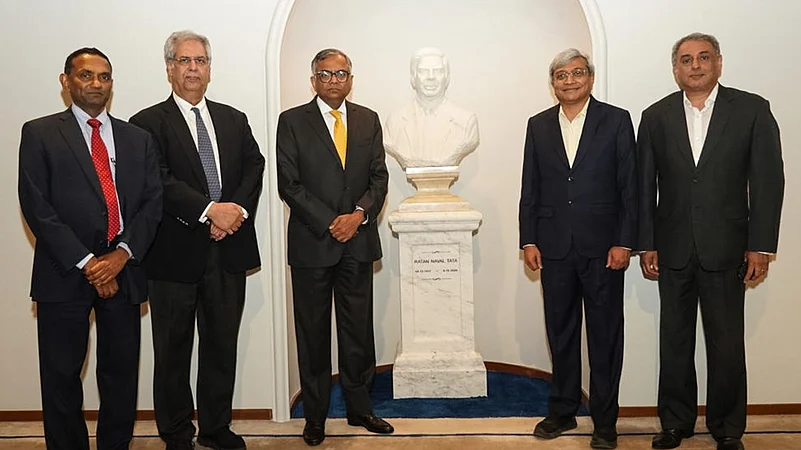
Bengaluru: Nine years after Cyrus Mistry was uncere moniously removed as chairman of Tata Sons, and a year after the death of patriarch Ratan Tata, the shadow of both still looms over the group. Long held as an exemplar in corporate governance, the group is now a house caught in a tussle. Sharp differences of opinion have emerged be tween the trustees of Tata Trusts, which together hold roughly 66 per cent stake in Tata Sons, the group’s holding company.
Considering the sheer breadth of sectors it operates in from steel to auto, software, retail and semiconductors, another power struggle at the conglomerate could have far-reaching ramifi cations. The markets’ concern is straightforward: prolonged infighting within Tata Trusts could paralyse decision making at Tata Sons just when clarity and unity are most needed.
With 29 publicly listed Tata firms collectively accounting for over $328 billion in market capitalisation and $180 billion in revenue, a governance freeze at the top could ripple across the markets and even the broader Indian economy. Amid this turmoil, Tata Trusts has recommended a third term for N Chandrasekaran as the Chairman of Tata Sons, the principal investment holding company and promoter of Tata group companies.
The development comes at a time when the trustees of Tata Trusts, the umbrella of philanthropic trusts that control 66 per cent of the equity share capital of Tata Sons, are vertically split over board appointment and governance issues. Reports suggest that the disagreements between the trustees arose over board appointments, access to sensitive information and the listing of Tata Sons.
The RBI had classified Tata Sons as an upper layer NBFC and given it a deadline of September 30, 2025 for listing. But, with the deadline passing Tata Sons has moved to deregister as an NBFC. A few days ago, Tata Trusts chairman Noel Tata, vice chairman Venu Srinivasan, trustee Darius Khambata and Tata Sons chairman N Chandrasek aran met with Home Minister Amit Shah and Finance Minister Nirmala Sitharaman.
While government intervention would raise a red flag, the fact that the trustees held a meeting with Union government ministers underlines the seriousness of the situation. The absence of a tower ing figure, after the death of Ratan Tata, is being felt. But the history of the Indian corporate sector is littered with examples of how, when strong promoters have passed away or did not have a clear succession line, the group either weakened or split.
Under Ratan Tata’s stewardship, the Tatas sailed through storms, with an approach that prized achieving con sensus and unanimity on issues. For a group that has prided itself on its principled approach to business, and has long been held in high regard for its integrity, this saga must be quickly brought to an end.
.jpg)




.jpg)