.jpg)


.jpg)

 English daily published in Bengaluru & Doha

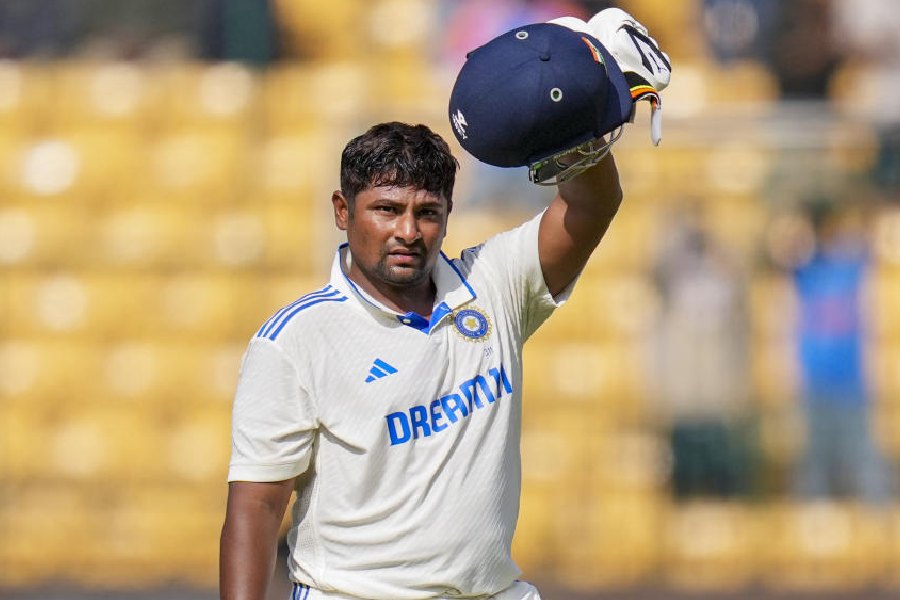
Sarfaraz Khan’s brilliance lost in selection blind spot
Sarfaraz Khan’s prolonged difficulty in persuading Indian selectors is not a matter of mere misfortune but a diagnostic of contemporary selection practice that undervalues sustained red-ball excellence. His first-class ledger is impressive: 4,685 runs at an average of 66, with 16 centuries and a triple century – statistics that place him high in the annals of the Ranji Trophy, arguably the most decisive domestic tournament in the country.
Yet the prevailing selection calculus privileges limited-overs visibility and franchise metrics in ways that distort assessment for the longest format. Sarfaraz’s T20 record – 1,188 runs at an average of around 22 with three fifties across almost 100 appearances – does not present him as a white-ball specialist, and that blemish in his shorter-format resume has been read, perhaps unfairly, as a signal of broader un-readiness in selectors’ eyes.
The management of his recent non-selection intensified the debate. His omission from even the India A squad has prompted robust public rebuke from senior commentators and lawmakers, crystallising a perception that injury narratives and discretionary explanations are sometimes invoked without the transparency domestic performers expect.
Such episodes risk delegitimising the Ranji pathway and may deter younger players from investing in the cumulative craft that has historically produced Test stalwarts. Ofcourse, Ranji numbers alone should not guarantee automatic Test permanence.
International cricket requires technique, temperament and adaptability against high-class bowling on unfamiliar pitches. Sarfaraz’s international sample is promising but incomplete: 371 Test runs in six matches, including one century and three fifties, indicate capacity but not yet sustained conversion at the highest level.
That incompleteness argues for extended, measured opportunities rather than precipitous exclusion. The forward path must be both practical and principled. Administratively, the BCCI should publish transparent, performance-weighted criteria for red-ball elevation, including defined run thresholds across consecutive Ranji seasons, guaranteed priority in India A red-ball fixtures for top performers, and a commitment to multi-match Test windows for incoming batsmen.
Institutionalising such ladders would convert discretionary opacity into accountable practice and restore Ranji as a credible pipeline. Practically, Sarfaraz must continue his domestic mastery while demonstrably broadening versatility.
Targeted stints in India A red-ball assignment, specialised coaching to refine strike rotation and game-man agement, and a deliberate programme to enhance limited-overs situational play will assuage selectors’ concerns about adaptability.
State associations and national coaches should collaborate to run measurable mentorship programmes, reporting progress against clear, published metrics. This is not sentimental advocacy for a single player but a systemic plea.
If Indian cricket wishes to regenerate a middle order after an era of celebrated incumbents, it must reconcile the hunger for immediate returns with patient, evidence-based talent cultivation. Sarfaraz Khan is a meaningful test case: how the selectors and administrators respond will reveal whether the sport prizes sustained domestic craft or merely the spectacle of fleeting success.
Principled action should convert applause into opportunity and reaffirm Ranji as the crucible of international readiness. Fans, pundits and officials will watch closely; the stakes are competitive and cultural.

.jpg)
.jpg)
.jpg)
.jpg)
.jpg)