.jpg)


.jpg)

 English daily published in Bengaluru & Doha

MAGA vs MIGA: How Israel is tearing America apart politically
Bengaluru: One year after Donald Trump returned to the White House, American politics is confronting a shift that few foresaw: Israel is no longer a bipartisan constant but a defining divide inside both major parties. Nowhere is this change more visible than within the movement that built Trump’s rise -- MAGA, the “Make America Great Again” coalition.
What once stood for economic nationalism, border fortification, and reduced foreign entanglements is now clashing with a newly assertive faction known as MIGA, short for “Make Israel Great Again.” The MAGA bloc, shaped by the belief that US power should be focused strictly on domestic revival, questions why Washington should offer unconditional military, diplomatic, and financial support to Israel.
To MAGA voters and influencers, endless aid sits uneasily beside Trump era promises of “America First.” They argue that US manufacturing, migration enforcement, and economic protectionism should not be overshadowed by commitments abroad. For them, Israel is becoming the latest test of whether America is willing to disentangle itself from foreign conflicts.
Standing opposite is the rapidly growing MIGA faction, which elevates unwavering support for Israel as a litmus test of conservative identity. This group includes Christian nationalists, traditional Republican hawks, and influential right-wing commentators. They treat the US Israel alliance not merely as strategic policy but as a moral and civilisational partnership.
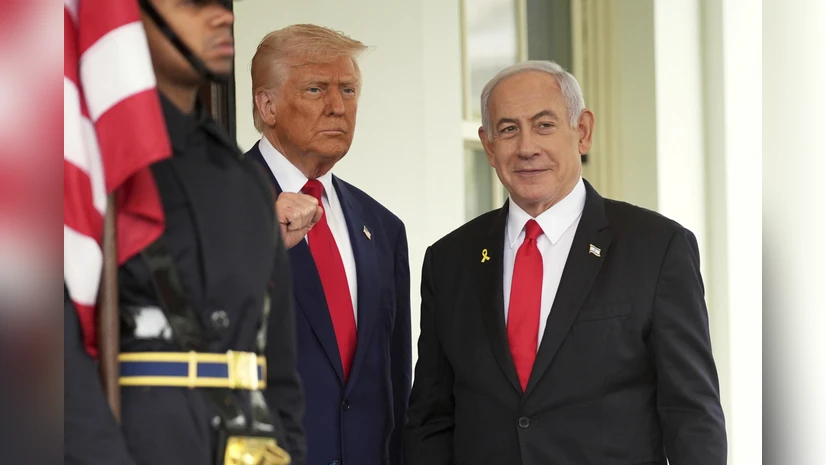
To them, criticism of Israel is indistinguishable from abandoning Western values, and MAGA scepticism is viewed as betrayal. This MAGA–MIGA rift has put Trump in a political minefield. His personal closeness to Israeli Prime Minister Benjamin Netanyahu and decades of pro-Israel positioning have aligned him with MIGA.
But his populist base, deeply shaped by anti-interventionist instincts since 2016, increasingly resists foreign entanglements. Trump oscillates between reaffirming strong support for Israel and expressing frustration, particularly when Netanyahu’s decisions complicate his political positioning.
Democrats are experiencing their own upheaval. Once uniformly pro-Israel at the leadership level, the party is now pulled in the opposite direction. Younger voters and lawmakers, shaped by social-justice politics and viewing Gaza through human-rights frameworks, have shifted the party’s centre of gravity.
Several Democratic members have rejected campaign donations from AIPAC, signalling that criticism of Israel is no longer politically taboo. Polling underscores the scale of this transformation. Younger Americans are markedly more sceptical of Israel’s military actions, and overall US favourability toward Israel has declined since 2022.
These shifts suggest that future elections may be shaped as much by attitudes toward Israel as by traditional domestic issues. What emerges is a political realignment in which Israel is no longer a stabilising point but a source of ideological identity. The split between MAGA’s “Make America Great Again” nationalism and MIGA’s “Make Israel Great Again” conservatism illustrates a new era: Israel has moved from bipartisan consensus to one of the sharpest fault lines in American politics.
.jpg)




.jpg)