.jpg)


.jpg)

 English daily published in Bengaluru & Doha

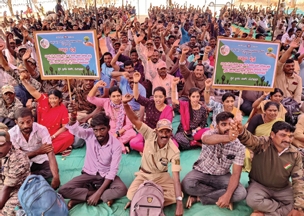
Outsourced, Verworked, Verlooked forest guards push back
Frontline staff who protect K'taka’s forests say years of exploitation, low pay, and unsafe working conditions have pushed them to the brink
Bengaluru: We demand that all Forest Department workers receive regular salaries directly from the department, not through out sourced agencies,” said Harish, Vice President of the State Wildlife Association, speaking to News Trail on Wednesday. His remarks come amid rising unrest among forest workers across Karnataka, who have submitted a detailed list of demands to the Forest Department and the State Government, seeking long-overdue reforms in their service conditions.
The protest, which began on Tuesday, saw around 1,500 Forest Department workers from across the state gather on both days, urging the government to extend to them the same protections, welfare measures, and job security given to permanent government staff. Many of the protesters are daily-wage or contract workers who have spent years performing the same duties as regular employees in wild life divisions — often without recognition, fair pay, or basic benefits.
These workers form the backbone of wildlife protection across Karnataka’s 36 sanctuaries, national parks, and tiger reserves. Their responsibilities include anti poaching patrols, tower surveillance, and responding to elephant, tiger, and leopard operations. They also maintain solar fences, drive safari vehicles, assist in rescue missions, and handle essential administrative duties. Despite their high-risk, labour intensive roles, they say their contributions remain invisible within the bureaucratic system.
“Our staff risk their lives every single day, but what do they receive in return?” Harish asked. Workers spend up to 26 days a month deep inside forests, often on 24-hour duty, away from their homes and families. Many suffer from chronic health issues due to the demanding nature of their work, yet must pay for their own medical treatment.
Sick leave results in salary deductions, and being unable to work for more than two months can even lead to termination. Protesters note that 8–10 guards die annually in wildlife attacks, with a similar number permanently disabled. Despite these dangers, frontline staff say they receive minimal safety equipment and inadequate institutional support.
They allege that senior officials ignore their hardships while relying on outsourced agency contracts that have displaced long-serving employees with 10–20 years of field experience. Among their demands, workers are calling for an end to outsourcing, especially for those employed before and after April 11, 1996, and during 2017.
They argue that all employees with more than 10 years of continuous service should be brought under the Welfare Development Act. Workers also question why driver posts have remained vacant for 15–20 years, leaving long-term drivers stuck on daily-wage systems without hardship allowances. They want immediate regularisation of these posts.
They further demand regularisation of office staff who have served for over a decade and express anger that experienced daily-wage workers were excluded from recruitment for ‘D’ grade forest inspector posts. On Wednesday, A.S. Ponnanna, Legal Advisor to the Chief Minister, and Meenakshi Negi, Principal Chief Conservator of Forests (PCCF), visited the protest site and assured the workers that their concerns would be examined and addressed at the earliest.
.jpg)




.jpg)