.jpg)


.jpg)

 English daily published in Bengaluru & Doha

India & its costly elections
With five state elections just weeks away, the EC has raised the campaign expenditure limit for all elections.
By Seema Chishti
An important data point published last week needs attention. Max Roser’s blog on Oxford University’s Our World in Data reminds the world that most of the world is poor, but for India, it specifically underlines the magnitude of the crisis – “99.5% of Indians spend less than $30 a day”.
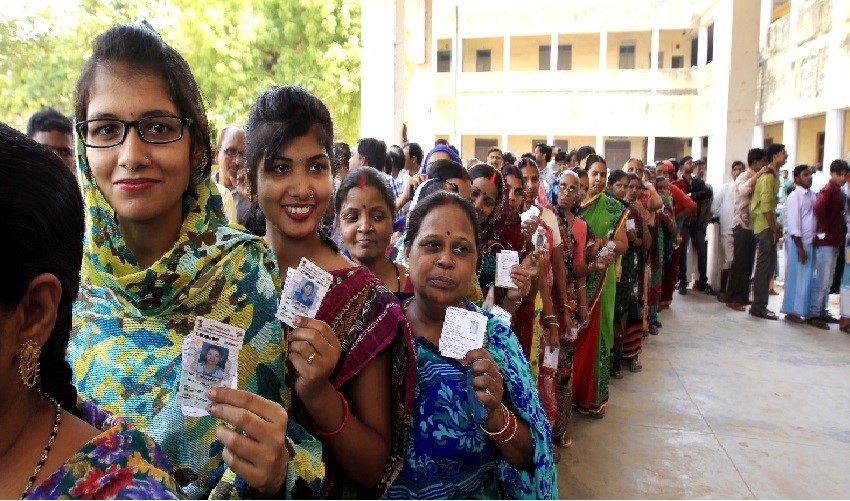
But when seen alongside the Election Commission’s (EC) notification, which with five state elections just weeks away raises the election expenditure limit for all elections henceforth from Rs 54 lakh- Rs 70 lakh to Rs 75 lakh-Rs 90 lakh for Parliamentary constituencies and from Rs 20 lakh-Rs 28 lakh up to Rs 28 lakh-Rs 40 lakh for Assembly constituencies, it is a red flag. It signals a complete disconnect between the direction democracy is taking in India and the lives of 99.5% of its people.
It also cites the Cost Inflation Index, which it says is “up by 32.08%”, and the need for more “virtual campaigning”.
Why Is the Raised Cap So Damaging?
This is damaging for both normative and practical reasons. Normatively, how can not having enough money be a criterion that stops a good candidate from entering the field? Our Constitution ensures that all adults can vote irrespective of the colour of their skin, faith, region, caste, class or educational qualifications. The rules for those eligible for fighting elections narrow the field no doubt, but the spirit of our Constitution says that all Indians must be able to think of being able to contest elections. The last thing that must be a hurdle is campaign finance.
Raising the limit for the maximum amount you can spend legitimises massive spending for influencing voters, and that deeply damages the health of a democracy. That too of a democracy that is composed of an overwhelmingly large number of people with limited means. In brief, making money the binding constraint for why people cannot contest polls pushes Indian democracy backwards, not forward.
The move is practically damaging as it distorts the democratic arena, more so in the current situation, where opaque campaign finance has already titled the board in favour of the ruling party.
EC Has Become a Deep Disappointment
So, instead of focusing on questions that election watchdogs have been hammering on, such as making the source of funding of parties more open and restricting the amount political parties can spend (which is a backdoor used to circumvent limits on candidate financing), raising limits of candidate spending take democracy even further away from the average voter.
The Association for Democratic Reforms had pointed out in 2020 that “nine working groups” (comprising Chief Electoral Officers of states and other ECI officials) presented their draft recommendations to the ECI, among which it was suggested that there needs to be a cap on the expenditure to be incurred for an election by political parties. In 2015, the ECI also recommended to the Ministry of Law a proposal to cap maximum expenditure of political parties to a multiple of half of the maximum prescribed limit for individual candidates with the number of candidates fielded.
It went on to recommend “that steps must be taken in this regard and the modalities must be worked out in a time-bound manner”. But far from meaningful reform, we see the Election Commission, designed to serve as an institution whose autonomy is central to maintaining India’s status as a democracy, being a deep disappointment.
2019: “Watershed Election” For Campaign Finance
2019 should have rung alarm bells for those interested in seeing that Indian democracy serves its poorest citizens, as at Rs 55,000 crore, or $8 billion, with the BJP spending almost half the amount, it was the most expensive election anytime and anywhere.
“In 20 years, involving six elections to Lok Sabha between 1998 and 2019, the election expenditure has gone up by around six times from Rs 9,000 crore to around Rs 55,000 crore,” said a Centre for Media Studies report in 2019. “It is interesting to see how the ruling party gears up to spend much more than others.” The sole response to such startling facts in a poor country, two years after a debilitating pandemic, cannot be to privilege the super-rich. The ADR termed 2019 as a “watershed election” because “a major source of poll funding is now corporate and in the name of transparency, anonymity is promoted in that process”.
Money Can’t Buy Votes, or Can it?
India is at a pivotal moment as far as the state of its democracy is concerned. It has seen a precipitous decline in its democratic standing, recorded meti

.jpg)
.jpg)
.jpg)
.jpg)
.jpg)