.jpg)


.jpg)

 English daily published in Bengaluru & Doha

‘The sky is my roof’: The grim reality of Bengaluru’s many homeless
Bengaluru
As winter tightens its grip on Bengaluru, the city’s glittering skyline and bustling streets conceal a stark and unsettling truth, thousands of people are spending their nights under the open sky, fighting cold, hunger, and neglect. While many retreat indoors wrapped in thick blankets, the city’s urban homeless are left exposed, their survival reduced to plastic sheets, tattered clothing, and sheer endurance. Their struggle remains largely invisible, overlooked by authorities and society alike.
“Many of us sleep warmly under thick blankets, but they are forced to make do with plastic sheets. Even the blankets provided are sometimes stolen by others living on the streets,” said Anitha, a social worker speaking to News Trail, describing the harsh realities faced by homeless individuals in Bengaluru during the winter season. The metropolitan city is witnessing a rapidly expanding urban homeless population, a crisis that continues to be largely ignored, reflecting a systemic failure to grasp the seriousness of the issue.
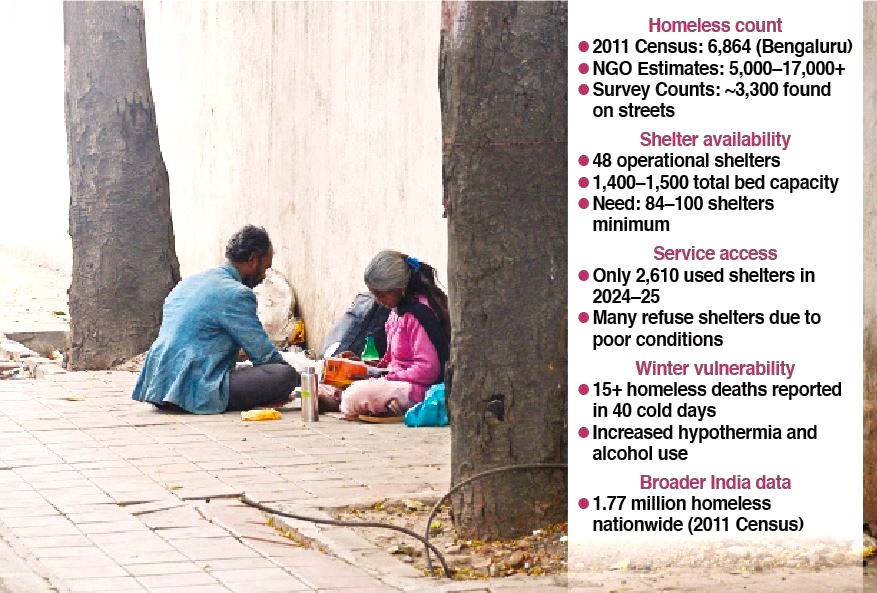
Countless individuals remain on the streets without shelter or protection, exposed to biting cold and deteriorating health conditions. Recent reports that more than 15 “unidentified” and “unknown” individuals have died in the last 40 days underscore the grim reality of lives abandoned to the cold, highlighting an urgent humanitarian concern that demands immediate attention. Anitha shared that some individuals increase their alcohol consumption to numb themselves against the icy temperatures.
Although organisations such as Project Smile provide bathing facilities, many avoid using them during winter, fearing that a shower would intensify the cold. This behaviour further highlights the extreme vulnerability and distress faced by the city’s growing homeless population, left to fend for themselves on the streets. “The government and the Greater Bengaluru Authority (GBA) must give greater priority to the urban homelessness crisis in Bengaluru and allocate sufficient financial resources to support related initiatives,” said Dr Ram Chandra, Director of the Indian Community Development Service Society (ICDSS) NGO and Secretary of the Impact India Consortium.
Despite the sanctioning of 74 night shelters within the Greater Bengaluru Authority limits, only 48 are presently operational under the National Urban Livelihoods Mission (NULM). Sources familiar with the system told News Trail that, considering Bengaluru’s rapidly growing population, the number of shelters should have increased to at least 100 by now. Several operational shelters are also reportedly plagued by infrastructure deficiencies and delays in payments for electricity, water supply, and other essential services.
The 2011 Census recorded 6,864 homeless persons in Bengaluru Urban. However, recent estimates vary widely. While surveys cited by the then Bruhat Bengaluru Mahanagara Palike (BBMP) present one set of figures, activists and non-governmental organisations (NGOs) place the number anywhere between 5,000 and 17,000. They point to chronic underreporting, funding shortfalls, systemic gaps, and an ongoing crisis in shelter availability. In 2024–25, only 2,610 individuals reportedly accessed night shelters, significantly lower than the city’s homeless population under any estimate, highlighting the limited reach and capacity of existing facilities.
Humanity over all
News Trail spoke to several social workers who regularly engage with people living on the streets. They said they consciously refer to them as “clients” rather than “homeless,” emphasising dignity over labels. They noted that many clients are functional members of the working class; the only difference is the absence of a permanent address. “The sky is my roof,” one client told a social worker, capturing the stark mindset of life on the streets.
Asha, another social worker, said many clients have families who either refuse to reconnect or remain in contact while the individuals themselves choose not to return home. “In many cases, families come forward only after the person’s death. It is a very painful reality to witness,” she said. Social workers added that several clients refuse to stay in shelters due to poor living conditions, including bed bug infestations, internal conflicts among staff or caregivers, restrictive curfew timings, insecurity regarding personal hygiene, and concerns about safety.
A major deterrent is the ban on alcohol consumption, which is paradoxical, as alcohol dependence is also one of the reasons many individuals end up living on the streets. “There has been a nearly 10% increase in seizure cases and a 2% rise in hypothermia. Excessive alcohol consumption during the cold has had a severe impact on their overall health as well,” said Dr Umar, Medical Coordinator of Project Smile. People living on the streets are highly vulnerable to winter-related illnesses and chronic diseases, and often struggle to access hospital care due to the lack of identification documents or the absence of a required bystander.




.jpg)
