.jpg)


.jpg)

 English daily published in Bengaluru & Doha

Who will control Bangladesh?
This week’s elections to Bangladesh’s National Assembly are less an exercise in democratic routine
than a referendum on the country’s political and ideological future, something which world capitals are
deeply interested in understanding. The election is about whether Bangladesh’s fragile democratic and secular foundations can survive the forces now competing to redefine the state.
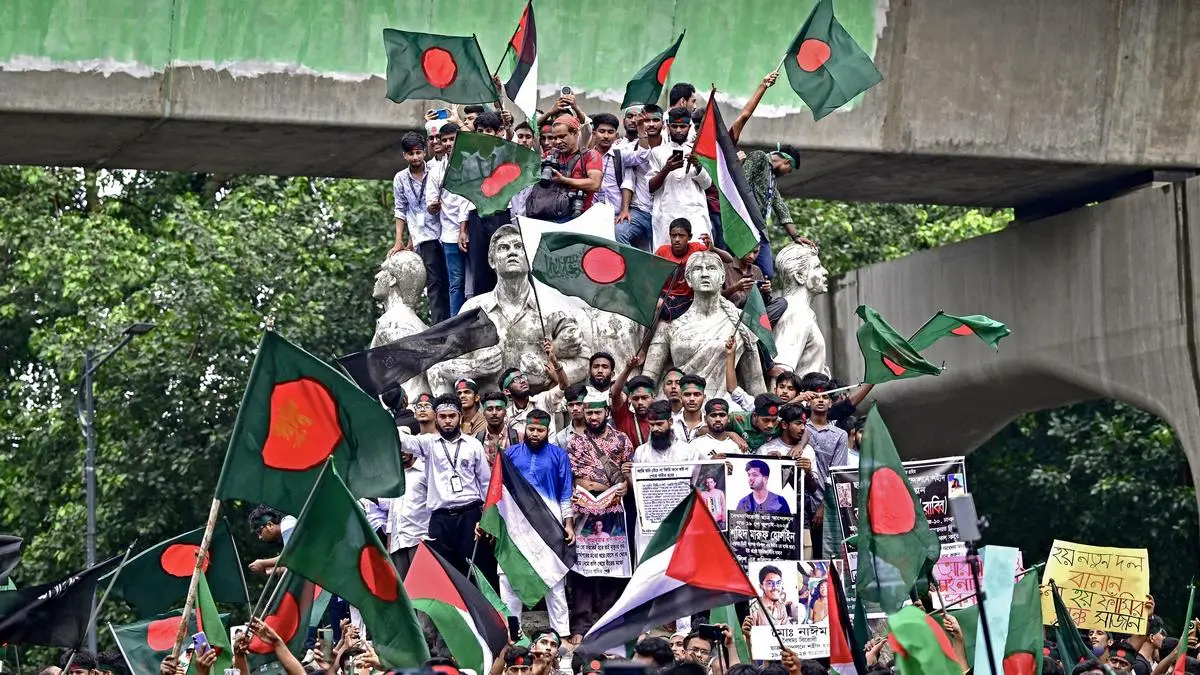
What was once scheduled as a conventional transfer of power is now unfolding in an atmosphere of street violence, labour unrest, bureaucratic capture, and deepideological polarisation in what can best be described as the unstable aftermath of the dramatic collapse of Sheikh Hasina’s government in August 2024. However, as Indian diplomats have said privately, any elected government is a better alternative than having a chaotic interim government continue to rule out of Dhaka—some form of a people’s mandate is better than an inimical power centre, which is pulled by many strings and belongs to none.
Two forces dominate this fractured terrain. One is the BNP, which has governed intermittently whenever the Awami League has been out of power. The other is Jamaat-e-Islami, a party still haunted by its role in 1971, when it collaborated with the Pakistani army during Bangladesh’s war of independence—an episode that ended in mass atrocities and genocide.The presence of Tarique Rahman, the scion to the Zia legacy left behind by his parents—General Zia
Ur Rahman and Begum Khaleda Zia—and the crowds he has been attracting, would indicate that the BNP could sweep the polls.
Jamaat leaders have openly rejected gender equality, insisting that women are not meant to rule. They have reaffirmed their long-term ambition to introduce Sharia law, a move that would fundamentally recast Bang-ladesh’s constitutional order and place liberal Muslims, religious minorities, and heterodox Islamic traditions in an increasingly precarious position.
From exile, believed to be somewhere in India, Sheikh Hasina has urged supporters to boycott the vote under the slogan “No boat, no vote”, a reference to the party’s elec-toral symbol. The aim is simple: delegitimise the outcome by suppressing turnout.
Privately conducted surveys suggest that the BNP, led by Tarique Rahman, is still best placed to emerge as the single largest party. It could plausibly win an outright majority. For New Delhi, then, February 12 presents no really good options— only gradations of risk. A BNP ma-jority might offer transactional stability, which will remain vulnerable to Islamist pressure as well as pressure from larger powers such as the US and China. A BNP-Jamaat coalition would raise sharper concerns about radicalisation and minority rights, besides links with Pakistan and Turkiye.

.jpg)
.jpg)
.jpg)
.jpg)
.jpg)