.jpg)


.jpg)

 English daily published in Bengaluru & Doha

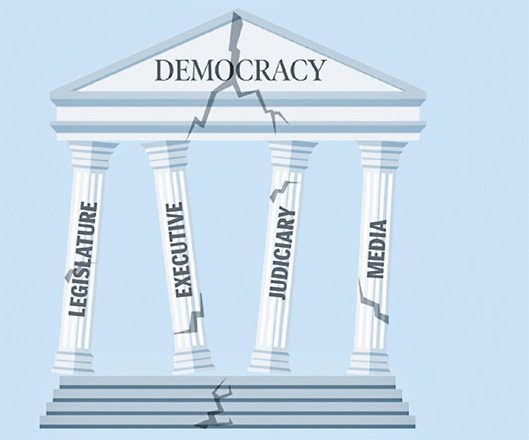
Journalism & the health of democracy
A country’s democracy, so- ciety and culture are often reflected in the quality of its journalism. Human beings are inherently social and driven by curiosity about the world around them. Journalism fulfils this need by acting as a bridge that con- nects individuals, society and the state. It is more than a profession of reporting facts; it is the heart- beat of a functioning democracy. Journalism provides a lens through which society can exam- ine itself. It exposes distortions, highlights injustice and brings hidden realities into public view.
The strength of a nation’s democ- racy is therefore closely linked to the fairness, independence and credibility of its press. In India, the press derives its authority from the constitutional guarantee of freedom of speech and expression. Although the Constitution does not grant a sep- arate or explicit provision for press freedom, the judiciary has repeatedly affirmed that the media enjoys the same rights as any citizen. In a parliamentary democracy, this freedom is cru- cial because citizens must remain informed about decisions that af- fect their lives. Ideally, the media functions as a watchdog.
It scrutinises power, protects individual reputations and holds governments account- able. By informing citizens and questioning authority, journalism strengthens democratic institu- tions and encourages transpar- ency in governance. However, the noble mission of journalism faces serious challenges today. What once served as a bridge between the people and the government is increasingly in- fluenced by political and corporate interests. Many media organisa- tions are backed by powerful in- dustrial groups or shaped by political agendas, which often weakens their commitment to truth and impartiality.
As a result, sections of the media have shifted from amplify- ing public concerns to promoting sensationalism and profit-driven narratives. The rise of fake news has further eroded public trust. In some cases, individuals enter the profession not to inform the public but to exploit journal- ism as a tool for influence, press- ure or even blackmail. Institutions and journalist or- ganisations that were meant to protect media professionals have struggled to address the har- assment and insecurity faced by journalists.
At times, these bodies risk becoming platforms for per- sonal ambition rather than collec- tive defence of press freedom. Despite these challenges, jour- nalism remains indispensable for any democracy. It is one of the few forces capable of keeping the ma- chinery of governance account- able. To regain its credibility and public trust, journalists must re- sist sensationalism and remain committed to truth and integrity.

.jpg)
.jpg)
.jpg)
.jpg)
.jpg)