.jpg)


.jpg)

 English daily published in Bengaluru & Doha

NITK launches NOMAD for real world AI
Mangaluru
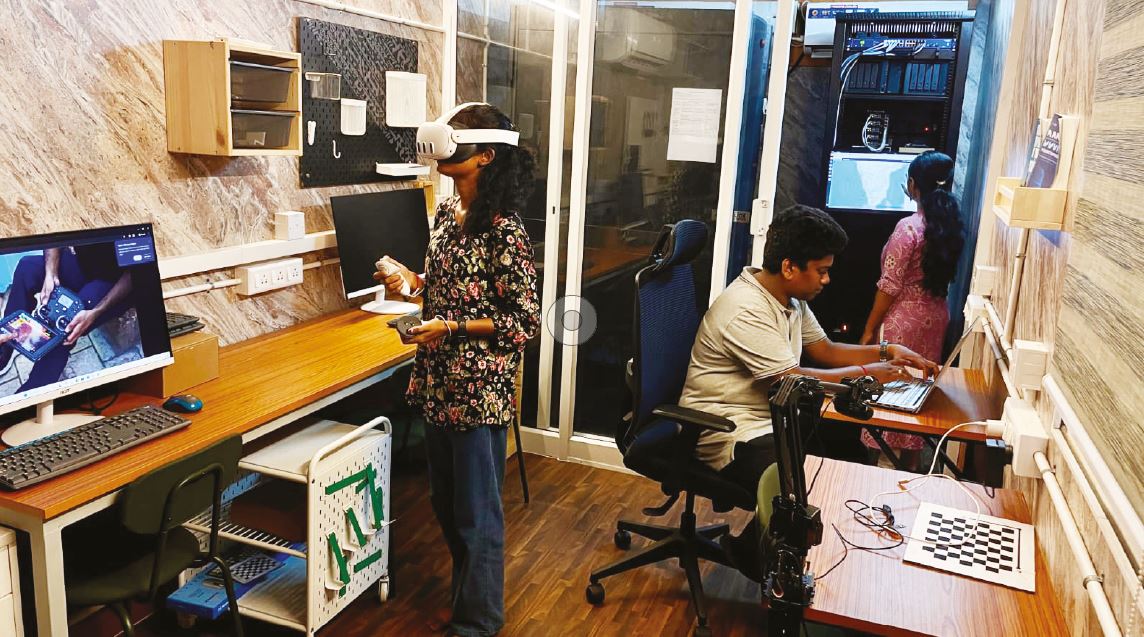
At a time when artificial intelligence is increasingly tied to data centres and uninterrupted connectivity, the National Institute of Technology Karnataka (NITK), Surathkal, has taken a different route. Its newly launched platform, NOMAD (Node for Open source Mobile AI Deployment), is built not for ideal conditions, but for the real world where systems often fail. Set up at the institute’s beachfront SEARCH research facility, NOMAD is not a conventional lab installation.
It operates out of a repurposed shipping container along the Arabian Sea coast, designed to function as a self contained AI unit in environments where power, connectivity and infrastructure cannot be taken for granted. The idea is simple but significant. Instead of depending on distant cloud systems, NOMAD brings computing closer to the point of use. In disaster zones, coastal regions and remote research sites, this shift can determine how quickly and effectively decisions are made.
To support this, the platform is built with multiple layers of redundancy. Power is drawn from four independent sources, grid supply, rooftop solar, a towable 15 kW solar battery unit and a diesel generator backed by UPS. Inside, NOMAD houses a compact but capable computing stack built on open source clusters, edge devices and high capacity storage. Plans are in place to integrate NITK’s high performance computing resources, further expanding its capabilities. At the same time, the space is designed to be used, not just observed, supporting teaching, experimentation and interdisciplinary work.
Its location adds to its relevance. Positioned within the SEARCH complex with basic living facilities, the platform allows researchers to stay and work on site. This reduces dependence on delayed or remote data and enables direct engagement with changing environmental conditions. The initiative has been led by Dr. Pruthviraj U, Associate Professor in the Department of Water Resources and Ocean Engineering. The work currently focuses on edge AI systems, water related applications and coastal disaster intelligence.
In situations such as flooding or landslides, where connectivity is often the first casualty, the ability to process and interpret data locally becomes crucial. The initiative is supported and actively mentored by NITK alumnus Padmanand Warrier (Electrical and Electronics Engineering, 1981 batch), a technology leader with extensive experience in large-scale systems and innovation. His involvement provides a strong foundation for the project, as NITK looks to expand NOMAD through interdisciplinary initiatives and integration into academic programmes.

.jpg)
.jpg)