.jpg)


.jpg)

 English daily published in Bengaluru & Doha

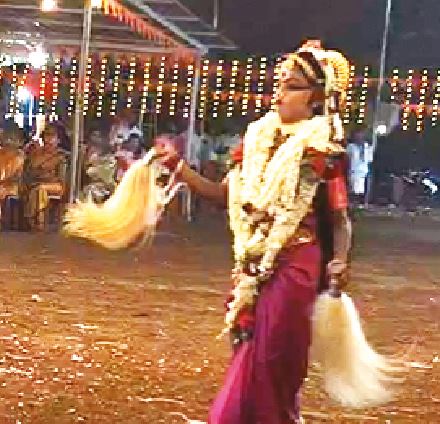
12-year-old boy keeps legacy alive; steps into Bhoota Kola
Mangaluru
In Tulunadu, spirit worship is not merely ritual, it is a living cultural continuum, deeply woven into the region’s identity. At a time when concerns are often raised about the gradual erosion of traditional practices, a remarkable incident from Karkala taluk offers a refreshing counterpoint. A 12-year-old boy has stepped into the sacred arena of Bhoota Kola, capturing the attention and admiration of the community. Samarth, a Class 7 student of the Government Higher Primary School in Soodi, Karkala, performed as a Bhoota impersonator, donning the traditional gaggara (anklets) and successfully participating in the ritualistic Kola.
What makes this feat extraordinary is not just his age, but the depth of tradition he represents. The event took place during the Pratishta Vardhantyutsava at the Shirlaalu Soodi Panglabettu and Mundli Mugerakala Daivasthana, where rituals began in the early hours. Samarth performed the role of the Thanimaniga, a female spirit deity, adhering to strict customs that require the performer to be unmarried. The ritual, typically conducted around 2 a.m., carries its own unique set of practices, including the tying of karimani and the ceremonial 'marriage' of the deity during the nema.
Belonging to the Mogera community, Samarth represents the third generation in a lineage of performers. His grandfather, Monu Panara, was a respected Bhoota Kola artist in the ajal (traditional jurisdiction) of the shrine. His father, Harish Dharmarasu, continues the practice today. With Samarth now stepping into the role, the continuity of this sacred tradition appears not only preserved but strengthened. “This is a tradition that has been passed down in our family.
I am learning from my elders and feel proud to continue it,” said Samarth, reflecting on his experience. Locals note that the Thanmaniga Kola is particularly demanding, both physically and spiritually. The ritual involves multiple deities, including Edmoor Mayagara Thanmaniga, and forms part of a larger network of sacred sites associated with Tulunadu’s rich spirit worship tradition, spanning the famed 66 Garodis of Koti-Chennaya and 33 Mugerakala shrines. “It is heartening to see the younger generation embracing and preserving our traditions. This ensures that our cultural identity remains secure in the future,” said S K Salian of Padibettu Barke.
Echoing similar sentiments, local resident Krishna Nayak described the act as “commendable.” He added, “Ancient traditions and practices can survive only when children are encouraged to take interest. This boy’s effort is truly inspiring.” For many in the region, Samarth’s performance is more than a display of talent, it is a sign of continuity in changing times. In an era where modernization often challenges age-old traditions, stories like this stand out. They remind us that culture is not just inherited, it is sustained through participation, passion, and pride. In the quiet village of Soodi, under the dim light of early dawn, a young boy has not only performed a ritual but also reaffirmed the enduring spirit of Tulunadu’s heritage.
.jpg)
.jpg)