.jpg)


.jpg)

 English daily published in Bengaluru & Doha

Muslims cite Krishna-era precedent, seek 5 berths in DKS ministry
Bengaluru
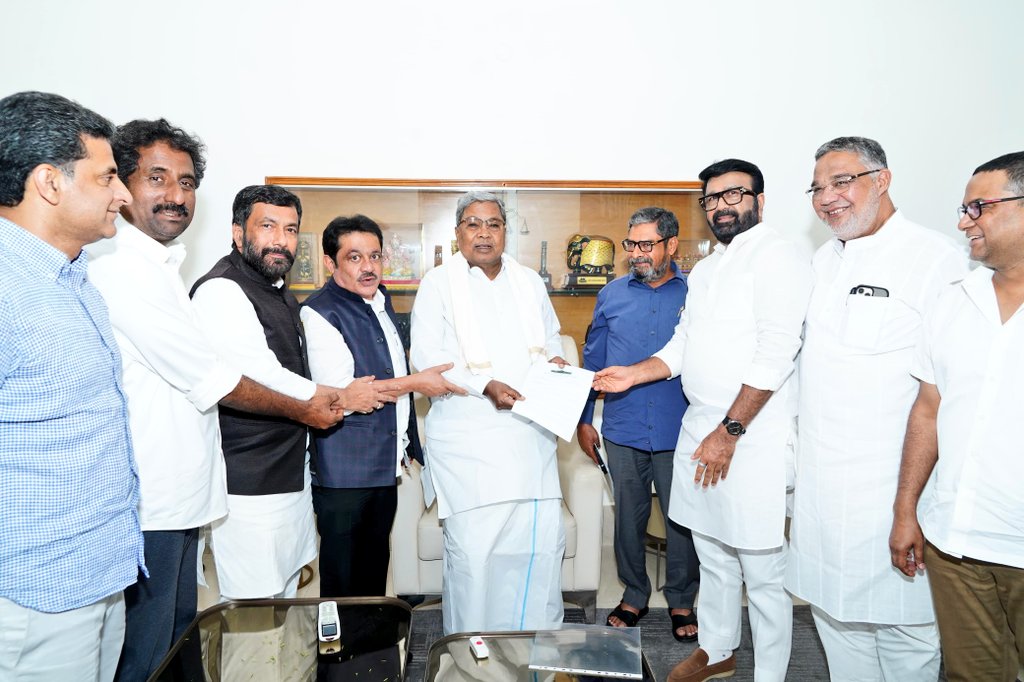
As discussions over a leadership transition in Karnataka gather pace, Muslim leaders and community organisations are pressing the Congress high command to ensure broader minority representation in a future ministry headed by D.K. Shivakumar. Citing the precedent of the S.M. Krishna government, which at one stage had five Muslim ministers, they are demanding at least five Cabinet berths for the community in any new Congress dispensation.
The demand comes amid intense political activity over a possible Cabinet reshuffle and leadership change, with social and regional balancing expected to play a key role in the composition of the next ministry. Muslims account for nearly 14 percent of Karnataka's population and have remained among the Congress party's most loyal support bases for decades. Community leaders argue that while the party has consistently benefited from minority support, particularly in Bengaluru, Old Mysore, Kalyana Karnataka and parts of coastal Karnataka, the community's representation in government has not kept pace with its electoral contribution.
Several Muslim leaders in contention
Several Muslim leaders are being discussed in Congress circles as potential contenders for ministerial positions. Besides incumbent ministers B.Z. Zameer Ahmed Khan and Rahim Khan, names frequently mentioned include U.T. Khader, N.A. Haris, Tanveer Sait and Rizwan Arshad. Political observers note that each of these leaders represents a different region and constituency within the Congress ecosystem. Tanveer Sait is among the party's most experienced Muslim faces and has served in previous Congress governments.
N.A. Haris commands considerable influence in Bengaluru politics, while Rizwan Arshad is seen as a younger leader with organisational and parliamentary experience. Though Assembly Speaker U.T. Khader currently occupies a constitutional position, many within the community regard him as one of the Congress party's most prominent Muslim faces with considerable administrative and legislative experience.
Representation imbalance under spotlight
The demand is also being framed in the context of representation enjoyed by other influential communities in the current Congress government. When Siddaramaiah constituted his Cabinet in 2023, Lingayats secured around eight ministerial berths while Vokkaligas received six. In comparison, Muslims were represented by only two ministers despite constituting a population segment roughly comparable to the Vokkaliga community in demographic terms.
Community organisations argue that the imbalance has become increasingly difficult to justify. They point out that Lingayats and Vokkaligas continue to dominate Karnataka's political landscape through ministerial representation, organisational positions and legislative influence, while Muslims often find themselves confined to a limited number of Cabinet slots.
“Representation is not merely about rewarding individuals. It is about ensuring that communities feel they have a stake in governance. If dominant communities can receive six to eight Cabinet positions, there is a strong case for giving Muslims at least five berths,” said a Bengaluru-based minority rights activist.
History bolsters demand for greater representation
The issue has also revived discussion on the historical representation of Muslims in Karnataka governments. Since Independence, Muslim leaders have been part of several ministries under Congress chief ministers, including Devaraj Urs, Gundu Rao, Veerendra Patil, S. Bangarappa, Veerappa Moily and S.M. Krishna. However, historians note that Muslim representation has rarely matched the community's share of the population.
During the tenure of S.M. Krishna between 1999 and 2004, the Congress projected an inclusive image and accommodated Muslim leaders in the government. Minority leaders point out that at one stage the Krishna ministry reportedly had five Muslim ministers -- Roshan Baig, Qamar-ul-Islam, C.R. Sageer Ahmed, A.M. Hindasgeri and Nafees Fazal. They argue that if the Congress could accommodate five Muslim ministers more than two decades ago, there is a stronger case for similar representation in a future ministry headed by DKS.
Test of Congress’ social justice plank
Political analyst Raghuram Prasad said Karnataka's Cabinet formation has historically been driven by caste arithmetic. “Every chief minister has had to accommodate Lingayats and Vokkaligas because of their political influence and legislative numbers. The question now is whether Congress wants to expand minority representation as part of its social justice narrative,” he said.
The debate assumes greater significance because the Congress’ electoral success in Karnataka has been built substantially around the AHINDA coalition — minorities, backward classes and Dalits. While Siddaramaiah remains the principal architect of that political formula, observers say Shivakumar will have to reassure each component of the coalition if and when he assumes the chief minister's office.
Congress insiders acknowledge that multiple communities are expected to press for a larger share in any future Cabinet. However, minority leaders insist that the party cannot afford to ignore Muslim aspirations at a time when it is seeking to consolidate support ahead of future electoral battles.
Political observers believe the final shape of a Shivakumar ministry will ultimately depend on balancing competing claims from Lingayats, Vokkaligas, Scheduled Castes, Scheduled Tribes, backward classes and minorities.
For the Congress leadership, the issue goes beyond the allocation of portfolios. It is increasingly being viewed as a test of the party's commitment to social representation and its ability to retain the confidence of one of its most reliable electoral constituencies in Karnataka.
.jpg)
.jpg)