.jpg)


.jpg)

 English daily published in Bengaluru & Doha

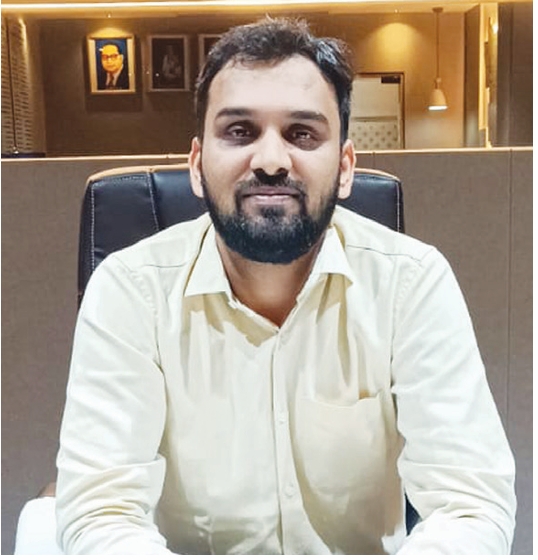
'WORKING FOR BETTER VILLAGES' A conversation with Dharwad ZP CEO Bhuvanesh Patil
Hubballi
Improving life in our villages is a big job. From fixing leaky school roofs to ensuring people get their health check-ups on time and gain access to government schemes, there is a lot of ground to cover. In Dharwad, Zilla Panchayat (ZP) Chief Executive Officer Bhuvanesh Patil is leading this effort. Since taking charge, he has focused on a few clear goals: improving exam results in schools, keeping villagers healthy, and ensuring government money reaches the right people without delay or cheating. By using technology, his team is trying to make the system faster and more honest.
With the rainy season starting, News Trail sat down with Mr. Patil to discuss his plans for the year. In this interview, we discuss how the government's guarantee schemes are working on the ground, how villages are preparing for the monsoon, and why he wants more citizens, especially women and youth to step forward and use these public programs.
News Trail: What are your top development priorities for the current financial year regarding rural infrastructure, education, and health care?
Bhuvanesh Patil: Our primary focus areas are education and health. In the education sector, specifically regarding SSLC results, Dharwad has shown significant improvement over the last two years. Previously, the district’s rank was often below 20. Two years ago we ranked 22nd, last year we moved up to 18th, and this year we secured the 12th rank. We are seeing gradual, incremental progress. We have given clear directions and are holding regular meetings to help our schools break into the top 10 this year.
In the healthcare sector, state government schemes are being actively reviewed by the District Health Society. Under the state’s Gruha Arogya initiative, screenings for non-communicable diseases like TB, blood pressure, and diabetes are conducted right at the citizens' doorsteps, with treatments provided at government or district hospitals. Furthermore, under the RBSK (Rashtriya Bal Swasthya Karyakram), we are ensuring rigorous health screenings for children to identify health defects, deficiencies, diseases, and developmental delays early on.
News Trail: What is the status of rural infrastructure development in the district?
Bhuvanesh Patil: In terms of infrastructure, pending works under the old NREGA scheme are actively being completed across the district. We are awaiting final government guidelines for the new scheme. Until those arrive, existing works continue without pause. Additionally, under the untied grants from last year, we achieved 100% of our targets. Our major focus for this year remains on repairing schools and Anganwadis. We want to ensure that no class room suffers from leaks and that all rural children have access to safe, basic infrastructure.
News Trail: How effectively are the welfare and guarantee schemes reaching the intended beneficiaries?
Bhuvanesh Patil: We conduct comprehensive review meetings for the Guarantee schemes on the 5th of every single month. The over all achievement rates across these schemes are highly encouraging. Minor field-level grievances are swiftly addressed by concerned officials through the Guarantee Yojana Authority. For the Yuva Nidhi scheme, we are focusing heavily on aligning financial aid with vocational training for our registered youth.
News Trail: Speaking of Yuva Nidhi, there is a perception that the response to the department's training programs has been somewhat lukewarm. Why is that?
Bhuvanesh Patil: While beneficiaries register promptly to receive financial assistance, the turnout for skill training can be low initially. This is primarily because many are actively hunting for jobs in the private sector on their own. However, we are not letting it rest; our team continuously calls and encourages them to attend. Our ultimate goal is to bridge the gap by matching the specific skill training we offer with the actual market demands and capabilities the youth need.
News Trail: You mentioned focusing heavily on education. We often hear that many students struggle with foundational learning. Are there any specific new initiatives this year to make basic reading and writing compulsory in schools?
Bhuvanesh Patil: Yes, this is a major focus for us. We have noticed that many children reach high school, even up to the SSLC level, without knowing how to properly read or write. To fix this from the roots, we conduct Functional Literacy and Numeracy (FLN) tests every June. This helps us accurately identify students who lack basic reading, writing, and math skills. Once identified, we hold special classes for them.
More importantly, from this academic year, we are strictly implementing a "Read and Write Clearly" program across all primary schools. During the daily morning assembly, it is now mandatory for students to read aloud from a Kannada news paper, an English newspaper, and various storybooks in front of the entire school. We rotate this daily so that every single child gets a turn. We are introducing dictation (Shuddha Lekhana) competitions. Our primary goal is to ensure that before any child steps into high school, their foundational literacy skills are abso lutely solid.
News Trail: With the monsoon season active, what measures have been put in place to tackle potential flooding and agricultural disruptions?
Bhuvanesh Patil: Our primary flood vulnerability lies around the Bennihalla and Tuparihalla streams, which impact roughly 50 to 53 villages across the Kundgol and Navalgund taluks. We monitor these areas very closely, and any damage to public infrastructure is reported instantly. The Deputy Commissioner has already conducted comprehensive disaster management preparatory meetings. If heavy downpours are predicted, early warnings are broadcast directly to the villagers. On the agricultural front, the department has ensured the seamless, timely distribution of seeds and fertilizers to support farmers during the sowing season.
News Trail: What is your message to the residents of Dharwad regard ing rural development and public participation?
Bhuvanesh Patil: The government has designed a wide array of welfare schemes, but their success hinges entirely on public awareness. If citizens don't know a scheme exists, they cannot benefit from it. That is why our departments—be it health, education, or RDPR—are working aggressively at the grassroots level. The Gram Panchayat is our frontline unit, and Panchayat Development Officers (PDOs) are vital to this mission.

.jpg)

.jpg)

