.jpg)


.jpg)

 English daily published in Bengaluru & Doha

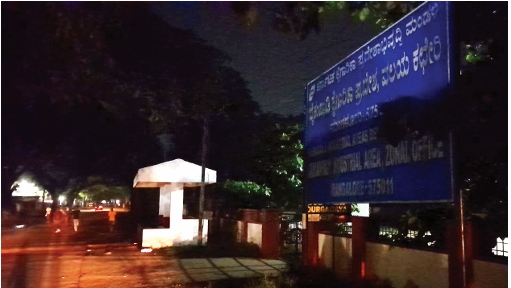
Baikampady’s darkness exposes infra gaps
Mangaluru,
Every day, thousands of workers stream into the Baikampady Industrial Area. Trucks carrying raw materials and finished products move in and out of factories. Public buses ferry employees, while industrial units continue operations long after sunset. On paper, it is one of Karnataka's most important industrial clusters and a major contributor to the economy of Dakshina Kannada. But when night falls, a different picture emerges. Large stretches of the Baikampady Industrial Area are plunged into darkness due to non-functional streetlights, forcing workers, motorists and residents to navigate poorly lit roads in what many describe as a glaring example of infrastructure neglect in a region that powers the local economy.
Industry representatives estimate that nearly 40 percent of the streetlights across the industrial estate are not functioning, leaving several major roads and internal stretches in dark ness every night. The situation has raised serious concerns over worker safety, road accidents, security and the overall image of an industrial estate that is now expected to play a bigger role in Karnataka's industrial growth story. Home to more than 500 industries and regarded as the second-largest industrial estate in the state after Peenya, Baikampady is not merely an industrial zone. It is an economic engine that supports thousands of jobs and sustains hundreds of businesses.
Yet, stakeholders say the area continues to struggle with basic civic infrastructure that should have been addressed years ago. Workers returning home after late-night shifts say travelling through some stretches has become increasingly difficult. Motorists complain of poor visibility, while pedestrians are often left walking through dark roads with little sense of security. The problem has be come more noticeable in recent months as road development works and traffic diversions have increased vehicle movement through internal roads.
In several locations, motorists are forced to rely solely on vehicle head lights to navigate stretches where streetlights have remained defunct for months. For workers who clock out after sunset, the issue is more than an inconvenience. It is a daily safety concern. "Streetlights are not a luxury in an industrial estate. They are essential in frastructure. Worker safety, vehicle movement and security depend on them," said M.D. Poojary, President of the Kanara Industries Association. According to him, nearly 40 percent of the lighting network requires immediate restoration and maintenance.
The darkness has also sparked concerns about security. Workers and local residents allege that poorly lit stretches create an environment conducive to anti-social activities. Many say they avoid travelling alone through certain pockets of the industrial estate at night. The concerns are not limited to industrial employees. Roads passing through Baikampady serve as an important link for residents of surrounding areas who use them daily for work, education and other activities. As a result, the impact of inadequate lighting extends far beyond factory gates.
What makes the issue particularly striking is the contrast between Baikampady's economic signifiiance and the condition of its basic infrastructure. The industrial area is home to several major manufacturing, logistics and processing units and has long been projected as a key destination for industrial investment in coastal Karnataka. However, stake holders argue that while discussions often focus on attracting new investments and expanding industrial activity, the maintenance of fundamental infrastructure frequently receives far less attention.
The issue comes at a crucial juncture for Baikampady. Just days ago, the region received a significant boost after being notified as a Special Investment Region (SIR), a move expected to pave the way for larger invest ments, easier access to funding and accelerated infrastructure development. The designation is being viewed as a major milestone that could transform the industrial land scape of the region over the coming years. Industry leaders believe the SIR status has the potential to unlock substantial public and private investment

.jpg)

.jpg)

