.jpg)


.jpg)

 English daily published in Bengaluru & Doha

As B'luru expands, Bidadi farmers fear livelihood loss
Bengaluru,
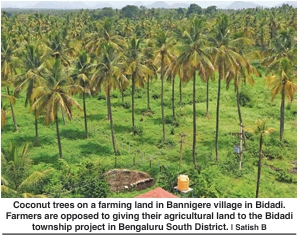
The proposed Greater Bengaluru Integrated Township (GBIT), also known as the Bidadi Township project, has sparked concerns among environmentalists, activists and farmer groups over its likely impact on agriculture and the environment. While being presented as a first-of-its-kind AI powered integrated city in India, the project would require the conversion of nearly 7,480 acres of green, fertile agricultural land of Bidadi into an urban space “To a raitha (farmer), land is not merely a property with a monetary value.
Whether there is rainfall or not, and regardless of the returns it generates, a farmer remains committed to protecting the land and preserving nature. That re lationship is fundamentally different from that of others”, said J.M. Veerasanghaiah, State Secretary of the Karnataka Rajya Raitha Sangha (KRRS), adding that further unchecked development in Bengaluru could become dangerous for everyone. He noted that the State government was creating divisions among local communities by assigning a price to agricultural land and persuading farmers to part with their holdings.
“Land is not only a source of livelihood for farmers but also their most reliable form of financial security. It offers a sense of stability that liquid money cannot”, he said. Veerasanghaiah said KRRS members organised a bike rally to Bairamangala on Monday in support of farmers protesting against the township project. “The government should not touch farmers' agricultural land. We stand firmly with the farmers opposing this project”, he added. Bidadi is known for its rich agricultural land, supporting horticulture, sericulture, dairy farming, and a range of traditional crops and plantations that contribute significantly to Karnataka's economy.
Environmental experts warn that the proposed township project could have far-reaching consequences beyond the displacement of farmers, affecting the region's ecology and the state's food security. Reports indicate that nearly two lakh trees may be felled to make way for the development, raising a larger question: Will Bengaluru continue to pursue development till the last tree is felled? “Instead of cutting down mature trees and planting saplings elsewhere, why can’t we preserve the trees that already exist? For generations, farmers have ensured that we never have to worry about food. We must respect their contribution because they are the back bone of our country”, said Bengaluru-based environmentalist Alexander James.
Questioning the conversion of productive agricultural land into a concrete township, James asked what would happen to farmers’ livelihoods and where citizens would turn if fertile farmlands were steadily replaced by urban developments. He argued that large scale projects of this nature should be planned in areas unsuitable for cultivation rather than on green land. Urban strategist and environmentalist Vinod Jacob described the proposal as “a misplaced choice and an unsuitable site for a township”. “The area's green belts have long moderated local temperatures, supported agriculture and biodiversity, and helped maintain ecological balance. Converting this land will erode those benefits while further straining Bengaluru’s already stressed resources, including water, roads and traffic management.




.jpg)
