.jpg)


.jpg)

 English daily published in Bengaluru & Doha

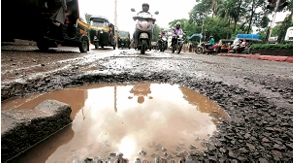
Pothole crisis: Crores spent, commuters still pay the price
Bengaluru,
Bengaluru’s pothole problem has remained one of the city’s most persistent civic challenges over the past five years, contributing to hundreds of accidents, more than a hundred deaths and worsening traffic congestion despite crores of rupees being spent annually on road repairs. According to official Karnataka road accident records, 452 pothole related accidents were reported between 2021 and 2024, resulting in 127 deaths.
Official data identifies 2023 as the worst year, recording the highest number of pothole-related accidents and fatalities. The deteriorating condition of roads comes as Bengaluru continues to struggle with one of the world’s worst traffic congestion levels. According to the Traffic Index 2025, commuters are travelling nearly 17 times slower than under free-flow traffic conditions, with journeys that earlier took an hour now often stretching to 90 minutes or more.
Although the civic authorities have spent crores on repairs, commuters continue to face long delays, damaged roads and increasing safety risks. Official records indicate that heavy rainfall, delayed repairs and recurring damage to road surbacked mapping. Former BBMP Chief Commissioner Tushar Girinath had earlier observed that fresh potholes were developing almost every day during the faces continue to affect both traffic movement and road safety, suggesting that potholes have become a recurring in frastructure failure rather than a seasonal problem.
The National Crime Records Bureau (NCRB) has also reported that Bengaluru topped all 18 major In dianmetros in deaths caused by negligence for four consecutive years. Experts attribute the spike in pothole-related accidents during 2023 to intense monsoon damage, delayed maintenance and increasing traffic volume.
Road engineering experts explain that potholes primarily develop when rainwater stagnates on the road surface. “Water remains in contact with the bitumen layer, causing it to strip away and loosen the aggregates. As vehicles continue to pass over the weakened surface, potholes begin to form,” an expert said.
Data tabled in the Karnataka Legislative Council shows that the then Bruhat Bengaluru Mahan agara Palike (BBMP) filled 1.07 lakh square metres of potholes during 2023-24, which increased to 1.78 lakh square metres during 2024-25, an increase of nearly 63 percent. Expenditure on pothole repairs also rose from Rs 7 crore to Rs 12.25 crore during the same period, indicating the growing scale of the problem.
In 2025, the Greater Bengaluru Authority (GBA), along with Bengaluru Traffic Police, identified around 4,500 potholes on major roads using GIS backed mapping. Former BBMP Chief Commissioner Tushar Girinath had earlier observed that fresh potholes were developing almost every day during the monsoon, making official counts an underestimate of the actual situation on city roads.
A senior traffic police officer also noted that authorities were receiving reports of nearly 200 new potholes every day. For commuters, the impact is immediate. Office goers, schoolchildren, delivery personnel and public transport users continue to spend more time on the road while navigating damaged stretches.
Apart from increasing travel time, potholes also expose motorists, especially two wheeler riders, to a higher risk of accidents. Experts believe that merely filling potholes will not solve the crisis. “Besides repairing potholes, roads must have adequate cross slope, technically known as camber, so that rain water drains away instead of stagnating.
Stormwater drains must also have sufficient carrying capacity,” another road engineering expert said. According to experts and civic voices, Bengaluru now needs durable road engineering, better drainage infrastructure, regular quality audits and greater accountability from civic agencies rather than relying on temporary patchwork repairs that fail with every monsoon.
.jpg)




.jpg)