.jpg)


.jpg)

 English daily published in Bengaluru & Doha

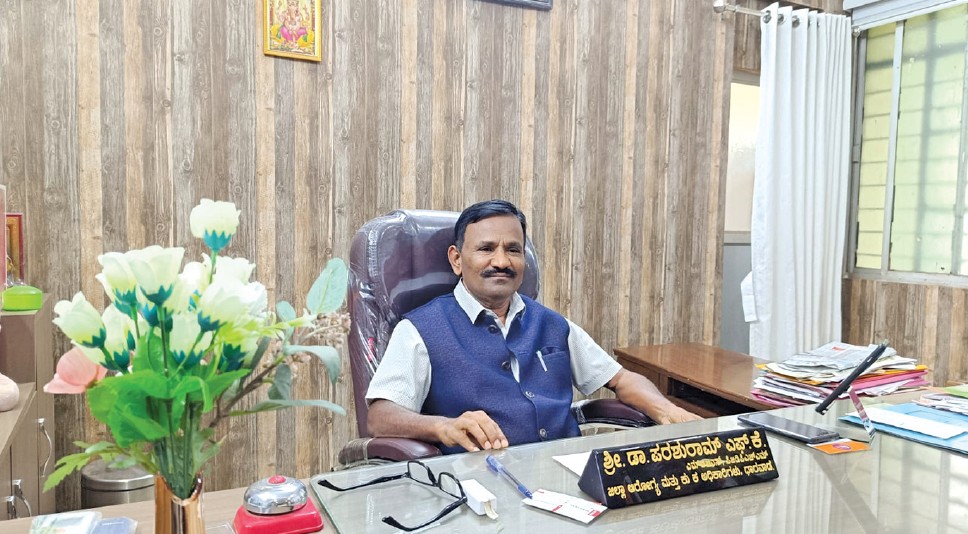
Dharwad DHO vows to transform public healthcare with patient-first approach
Dharwad
Taking the reins of a district's public health system is a massive undertaking, but for newly appointed District Health Officer Dr. Parashuram F.K., it is a long-awaited opportunity to redefine patient care. Sitting down with News Trail for an exclusive conversation, Dr. Parashuram shared his frontline strategies for bridging the rural healthcare gap, the relentless drive that shattered regional organ donation records, and how door-to-door wellness schemes are transforming lives across the district.
You recently took charge of the district’s health administration. How has the experience been so far, and what drives your vision for this role?
Dr Parshuram: It has been an incredibly encouraging first few days. My primary objective in stepping into this position is to ensure that the department delivers optimum, high-quality healthcare services to the public. There is a profound sense of satisfaction in being given the opportunity to serve the community directly, and I am eager to collaborate with my team to drive meaningful reforms.
Public hospitals often carry a reputation for being stressful environments. What is your primary agenda to change this perception?
Dr Parshuram: My core agenda is simple: every single patient who walks into a government healthcare facility in pain, distress, or anxiety should leave with a smile. To achieve this, we are strictly addressing administrative and operational loopholes. I have issued rigid, clear instructions to all medical staff and administrative personnel regarding accountability. We are proactively reviewing our service delivery pipelines so that the poorest segments of our society receive empathetic and timely treatment.
Staff shortages and infrastructure limitations frequently plague rural healthcare. How is Dharwad currently positioned?
Dr Parshuram: We are systematically addressing these gaps. Currently, our administrative network oversees 32 rural Primary Health Centres (PHCs), 19 Urban Health Centres, 21 Namma Clinics, 3 General Hospitals, and 1 District Hospital, alongside supporting two medical colleges.
To bridge human resource deficits in rural belts, we recently conducted walk-in interviews.
Out of seven vacant medical officer posts, five qualified MBBS doctors were instantly recruited and deployed. Furthermore, the Community Health Centre (CHC) at Aminbhavi was recently upgraded to a full-fledged facility, inaugurated by the Honorable Minister Dinesh Gundu Rao. While it will take some time to make it entirely full-scale, human resource streamlining is moving at a rapid pace.
How is the department managing round-the-clock availability of staff at the village level, and what impact has this had on maternal metrics?
Dr Parshuram: We have implemented strict 24/7 shift structures across 20 designated round-the-clock PHCs, ensuring three staff nurses work on rotating 8-hour shifts alongside two dedicated doctors. We have explicitly mandated that where staff quarters are available, doctors must reside at headquarters. Where quarters are lacking, we have formal expressions of interest submitted to the government for immediate approvals.
This rigorous oversight has yielded excellent results.
Over the past two years, maternal and infant mortality rates within the district have plummeted drastically. Most historical mortalities recorded locally were actually terminal cases referred from neighboring districts to the Karnataka Institute of Medical Sciences (KIMS). Local institutional deliveries have scaled up safely.
Taluka hospitals often face critical shortages of specialized doctors, which heavily overburdens secondary facilities like KIMS. How are you addressing this?
Dr Parshuram: We are using a strategic "triad system" to deploy specialists—pooling a pediatrician, a gynaecologist, and an anaesthetist as a single cohesive unit to understaffed talukas like Kundgol. We are actively working through human resource channels to safely extend services, even considering age-limit relaxations for highly experienced gynaecologists to optimize field operations. Resolving these shortages locally directly reduces the referral burden on KIMS, keeping primary care decentralized and highly effective.
Dharwad has quietly built an exceptional track record in state-level healthcare schemes recently. Could you highlight some of these milestones?
Dr Parshuram: I am immensely proud to share that Dharwad currently ranks first in Karnataka and third across India in organ donation registrations. When I first looked at the figures, the district had a mere 500 organ donation pledges. We took it up as a challenge, and through aggressive micro-campaigns, we have achieved 12,175 organ donation registrations. Additionally, we hold the top rank in the state for the National Tobacco Control Programme (NTCP) execution and the Non-Communicable Diseases (NCD) tracking systems, achieving nearly 100% of our targeted goals for hypertension and diabetes management.
What is the current status of the specialized Human Papillomavirus (HPV) vaccination campaign in schools?
Dr Parshuram: The HPV vaccination drive, aimed at preventing cervical cancer among young girls, is actively underway. We faced minor structural delays due to school vacations, but operations have resumed at full capacity. We have achieved roughly 30% to 40% of our designated target so far, and our team is working closely with educational institutions to achieve 100% saturation in the coming weeks.

.jpg)

.jpg)

