.jpg)


.jpg)

 English daily published in Bengaluru & Doha

Majority through mergers and acquisitions
In order to attain two-thirds majority in the Lok Sabha, the Bharatiya Janata Party is sparing nothing from its bag of tricks. Having failed to attain even the simple majority during the 2024 Lok Sabha elections, the party has now adopted the strategy of encouraging defections, splits and mas floor-crossing from the opposition parties. It aims at reaching the magic figure of 360 in the house of 543 in order to get the Delimitation Bill passed which will allow it to reshape the legislative landscape. Despite much braggadocio and its slogan of “400 ke paar”, it was restricted to 230 last time.
Now it has begun actively pursuing the strategy of absorbing opposition leaders and gradually but stealthily engineering mass party defections to expand its legislative strength and move closer to a two-thirds majority in Parliament. The party uses this approach to secure the necessary constitutional mandate for amendments. The strategy mainly relies upon mergers and acquisitions, if not through elections. In April, it engineered defections in the Aam Aadmi Party (AAP) and took away 10 of its MPs.
Next it was the turn of Trinamool Congress where a huge chunk of its members of Parliament were encouraged to claim themselves as ‘a separate block’ and later merge with National Citizens Party of India (NCPI), a Tripura based obscure political entity. These included worthies and close loyalists of Mamata Banerjee such as Shatabdi Roy, Kakoli Ghosh Dastidar, Yusuf Pathan and Sayoni Ghosh. More recently, six of the nine MPs of Shiv Sena (UBT) rose the banner of revolt against the official party and have merged their faction with the Eknath Shinde-led Sena which forms part of the ruling National Democratic Alliance (NDA).
While on the surface, these mass defections, crossovers and splits save the MPs from disqualifications, the moral legitimacy of their role is questionable. And given the enormous financial clout of the BJP, the role of these resources is not beyond imagination. At another level, the BJP has adopted the strategy of chewing the allies at the edges and gradually subsuming some of them unto itself. Having been partner with the Janata Dal United (JDU) in Bihar for quite a few years, it succeeded in easing out its leader Mr. Nitish Kumar and replacing him with its own leader Samrat Choudhury as chief minister.
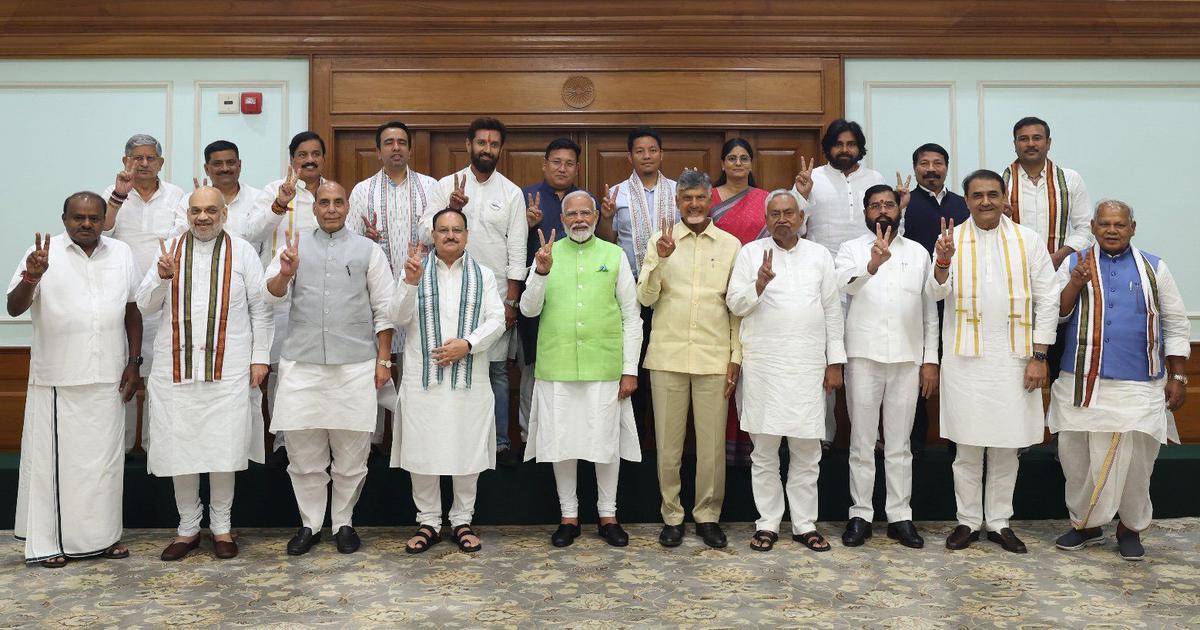
In Andhra Pradesh, the alliance with Telugu Desam Party (TDP) has offered it limitless prospects of growth in a state where it is almost non-existent. It is eyeing a similar approach towards the Janata Dal Secular (JDS) in Karnataka. A beginning can be seen in a key family member of the party supremo Deve Gowda winning the Lok Sabha election on BJP ticket from Bengaluru Rural in 2024. All these are part of Operation Lotus-II engineered by the BJP and signal a shift from winning a political majority to political management through inducement and intimidation.

.jpg)
.jpg)
.jpg)
.jpg)
.jpg)