.jpg)


.jpg)

 English daily published in Bengaluru & Doha

Govt data exposes failure of concrete walls as coastal degradation rises
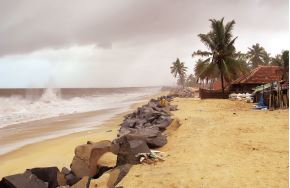
An alarming 48.4% of Dakshina Kannada’s coastline has eroded over three decades, revealing the systemic failure of traditional concrete barriers. Government reports and technical studies now demand an urgent paradigm shift toward soft engineering, eco-restoration, and planned inland relocation to protect vulnerable coastal communities and fragile ecosystems. Official data submitted to the Lok Sabha by the Ministry of Environment, Forest and Climate Change (MoEFCC) reveals a severe environmental crisis unfolding along Karnataka’s coastal belt.
According to findings from the National Centre for Coastal Research (NCCR)—which mapped shoreline dynamics using satellite imagery and field surveys between 1990 and 2018—nearly half (48.4%) of Dakshina Kannada’s 36.66 km shoreline has succumbed to sea erosion. While half of Karnataka’s total shoreline remains stable, spatial vulnerability varies significantly across districts.
Dakshina Kannada suffered 17.74 km of land loss out of its 36.66 km stretch, while Udupi district recorded 34.7% erosion, affecting 34.96 km of its 100.71 km shoreline. Uttara Kannada documented the lowest erosion footprint in the state at 12.3%, comprising 21.64 km of its 175.65 km coast. Nationally, the NCCR study indicates that 33.6% of India’s coastline is eroding, compared to 26.9% undergoing accretion and 39.6% remaining stable.
To evaluate severe climate hazards, Multi Hazard Vulnerability Maps at a 1:25,000 scale were compiled by the Indian National Centre for Ocean Information and Services (INCOIS), incorporating extreme water levels, shoreline migration trends, sea-level rise metrics, and high-resolution terrain mapping. Documented findings attribute the escalating shoreline recession along the western coast to a combination of climate pressures and direct human interventions.
Accelerating climate-driven sea-level rise exacerbates storm surges and hightide flooding. At the same time, uncontrolled sand extraction, combined with the construction of ports, seawalls, and breakwaters, interrupts natural littoral drift and sediment transport. This structural disruption, compounded by the destruction of mangrove vegetation and coastal sand dunes, removes primary defense barriers against high-energy wave action, while the increased frequency of cyclonic events along the Arabian Sea further destabilizes coastal sediment balances.
For over three decades, state interventions predominantly relied on heavy engineering, such as dumping granite boulders and constructing concrete sea walls. However, official engineering reviews and academic research indicate that these methods have failed to protect vulnerable stretches like Kotepura, Udyavara, Kodi Bengre, and Mazhali, despite expenditures exceeding ?200 crore over the past 25 years.
A technical paper coauthored by marine geologists at Mangalore University notes that coastal erosion is fundamentally a natural process of interaction between wind, water, and sand to maintain ecological equilibrium. Constructing artificial hard structures disrupts this equilibrium, preventing natural sediment redistribution and forcing wave energy to erode adjacent beaches.
Furthermore, technical reports from the Minor Irrigation Department have repeatedly warned against allowing human habitation on exposed stretches such as Kotepura near Ullal, Padukere near Udupi, Rabindranath Tagore Beach in Karwar, and Ganesh Bagh Beach in Ankola. In response to the growing crisis, the State Government has drafted a Shoreline Management Plan aligned with the Coastal Regulation Zone (CRZ) Notification, 2019, alongside initiating the World Bank-funded Karnataka Strengthening Coastal Resilience and the Economy (K-SHORE) project.
The active framework prioritizes three strategic objectives: developing resilient coastal protection mechanisms adapted to extreme weather events, safeguarding the economic stability of coastal fishing communities through sustainable practices, and addressing marine plastic pollution across coastal beaches. Policy evaluations suggest moving away from rigid concrete sea walls toward nature-based solutions, including beach re-formation, sand replenishment, dune preservation, and artificial eco-reefs. Environmental assessments further highlight proposals to allocate state funding toward constructing safe, fully equipped townships outside the CRZ boundaries, ensuring long-term safety for coastal families while enabling natural shoreline restoration.
.jpg)

.jpg)