.jpg)


.jpg)

 English daily published in Bengaluru & Doha

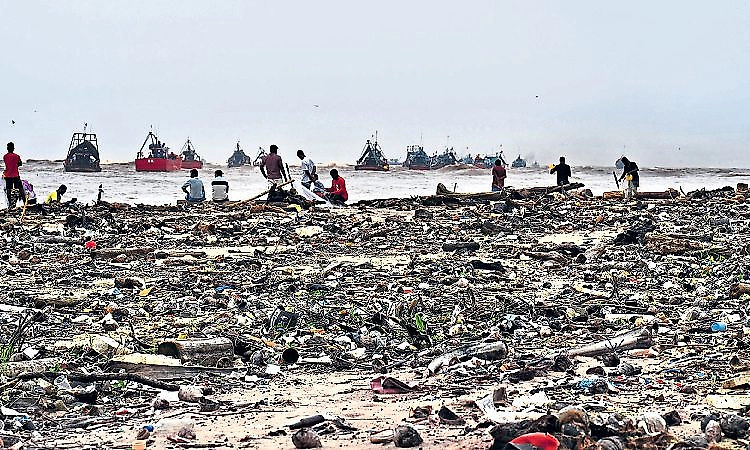
Bengre waste highlights growing threat to Mangaluru’s coast
The growing accumulation of plastic, household waste and other floating debris along Bengre Beach has once again drawn attention to the increasing pressure on Mangaluru’s fragile coastal ecosystem. What should be a clean and scenic stretch of shoreline is in creasingly becoming a visible reminder of how waste gener ated on land eventually finds its way into the sea. Plastic bottles, carry bags, food wrappers, flower offerings and other discarded materials have been washing ashore at the Bengre Beach endpoint, affecting the appearance of the coastline and raising concerns about the impact of marine pol lution on aquatic life.
Environmentalist Dinesh Holla said the issue should not be viewed merely as a problem of beach cleanliness, but as a warning about the larger ecological system connected to the sea. “The sea is the cradle of rivers. When the sea remains healthy, rivers can flow naturally, rainfall can remain part of the normal ecological cycle and the natu ral system can function properly. The sea and the Western Ghats have an inseparable re lationship. Unfortunately, today our seas are increasingly being treated as dumping grounds,” he said.
According to Holla, plastic, solid waste, sewage from urban areas and toxic effluents from industries are finding their way into the marine environment. He said the lack of concern for the sea is evident not only among the public but also among those responsible for protecting the coastal environment. “People go to the coast to enjoy its peaceful atmosphere, but some of the same people throw the waste they carry into the sea. It is ironic that people who pollute the sea then go to the fish market and ask whether fresh fish is available,” Holla said.
He stressed that marine or ganisms play an important role in maintaining the health of the ocean and that contin ued contamination could have consequences far beyond the shoreline. “All rivers eventually reach the sea. The freshwater that enters the sea becomes part of the water cycle, evaporates, forms clouds, moves towards the Western Ghats and returns as rain, eventually becoming rivers again. If the sea becomes increasingly contaminated year after year, we must seriously think about what the future holds for agriculture and drink ing water,” he said.
Holla also pointed to the importance of mangrove ecosystems in protecting coastal areas. Mangroves act as natural buffers along the coast and play an important role in main taining coastal and backwater ecosystems. “If mangrove forests are dam aged by marine waste and oth er pollution, the consequences can extend to the coastal and backwater systems and may also contribute to increasing coastal erosion,” he said. The accumulation of waste at Bengre has highlighted the need for regular removal of marine debris, but environmentalists say cleaning the beach alone cannot address the root cause.
Preventing plastic, sewage and other waste from entering riv ers, drains and the sea must form part of a broader coastal protection strategy. Holla called for stronger en forcement by the district ad ministration against dumping and pollution. “The district administration must take strict legal action against those who dump waste into the sea. Industries that dis charge toxic effluents into the marine environment must also face stringent action, irrespec tive of who attempts to exert pressure.
If decisive action is not taken today, we may have to face serious environmental disasters in the future,” he said. The waste accumulation along Bengre’s shoreline there fore represents more than a cleanliness issue. It is a warning about the interconnected na ture of rivers, the sea, rainfall, ag riculture, marine life and human activity, and the need to protect the entire ecosystem before the damage becomes irreversible.

.jpg)

.jpg)