.jpg)


.jpg)

 English daily published in Bengaluru & Doha

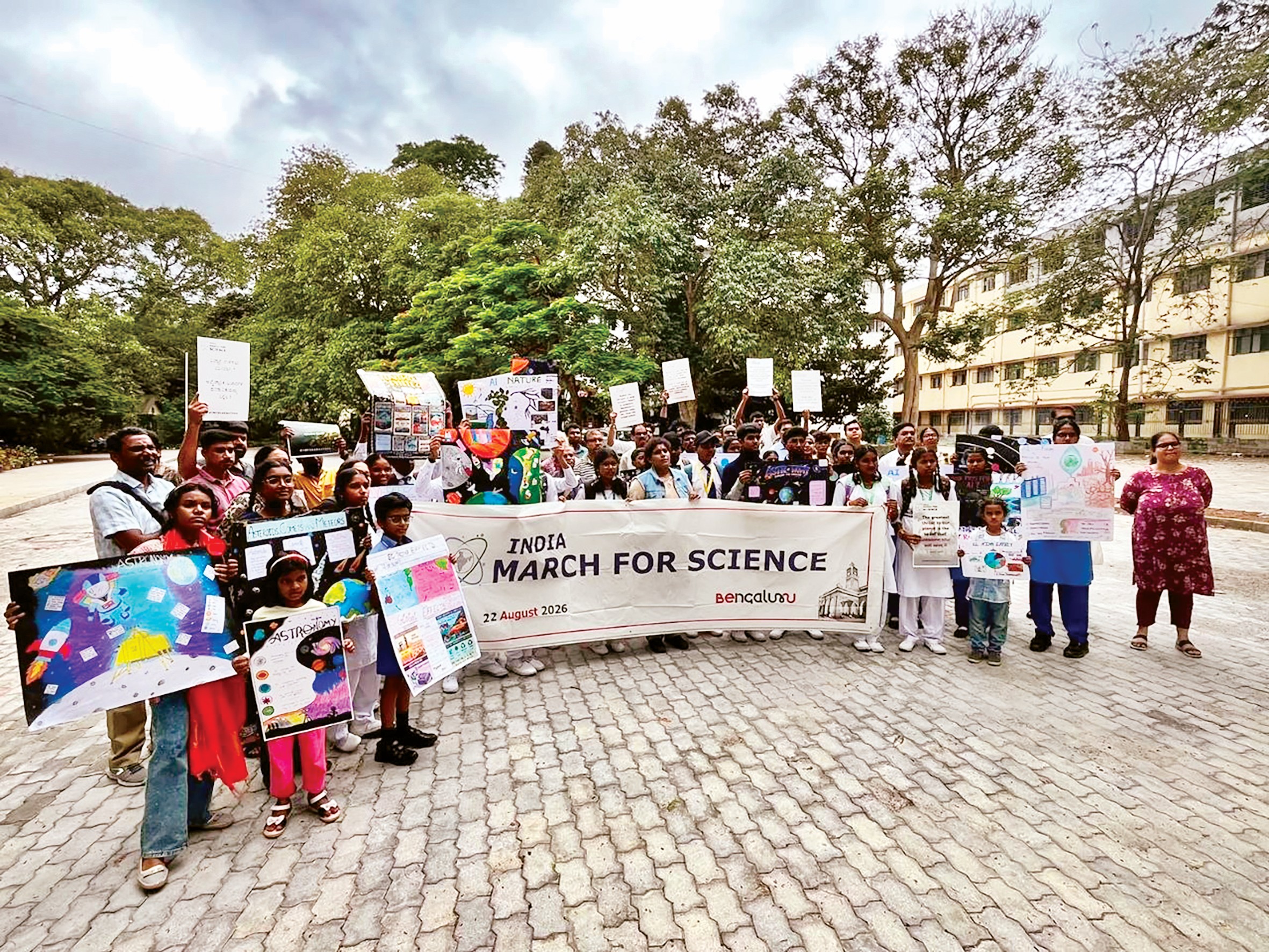
Science march flags decline in edu, research, scientific temper
Bengaluru
The India March for Science (IMFS) took place in the city on Saturday to highlight the declining state of science education and related issues in the state. The march was held at the Bharat Scouts and Guides venue, where educators, students and civil society members marched around the track, demanding scientific temper, increased research funding, evidence-based policymaking, and protection of public education and ecological resources.
The gathering was then addressed by eminent scientists, educators and civil society members on a variety of concerns, ranging from KPS Magnet Schools to threats to the Bengaluru University Biopark. Organising Committee member of IMFS Bengaluru, Anand Raj, opened the event by tracing the origins of the March. He highlighted how human curiosity and the drive to solve unknowns led to the scientific method, making knowledge testable and shaping our collective outlook on the past, present and future.
Dipti B., a member of the Breakthrough Science Society, spoke against superstitious beliefs and how fraudsters are fooling people by exploiting such beliefs. “All of us here are exposed to it. There are so many varieties of superstitions and, most importantly, the ones that are killing people. This is the reality of our country today. In Karnataka, in 2017, we passed what is called the anti-superstition Act, which stopped these inhumane practices. Especially women were losing their lives,” Dipti said.
She went on to speak about the AstroTalk application, which promises to predict people’s future based on their date of birth. She called on those present to engender the spirit of scientific enquiry and reject superstitions. Geoscientist C.P. Rajendran spoke about the need to eradicate superstitions and increase investment in scientific research, ecological protection and evidence-based policymaking.
Astrophysicist Dr Jayant Murthy also addressed the gathering and spoke about contemporary scientific research. “Many of us in India think that we are doing science as well as anywhere in the world. But the problem is that it's such a limited area. As a nation, we spend about 6% of our GDP on science. We need money to do things. More than that, we are stuck with procedures and politicians; no one really understands what science is.
cience is the need to learn about the world. Many times in India we are stuck with different pressures that we don’t remember the joy of doing science,” Dr Murthy said. The audience was also addressed by Aishwarya C.M., an educator who spoke about the loopholes in the New Education Policy (NEP) and the plan for KPS Magnet Schools, which threaten the closure of thousands of government schools in the state. She was followed by science teacher Rajesh Bhatt, who condemned the condition of current textbooks, with the syllabus not covering the periodic table and evolution, while including chapters on ‘satvik’ food.

.jpg)
.jpg)