.jpg)


.jpg)

 English daily published in Bengaluru & Doha

Go beyond reels & political rhetoric
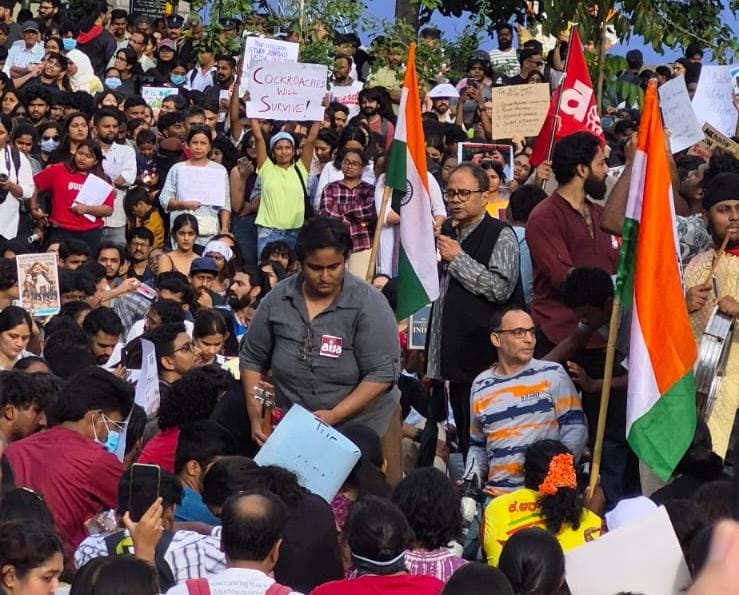
Political leaders, across their multiple divides, are all focused on one single constituency: youngsters. It is no surprise, because the largely social media driven campaign, not against any particular political party but against the well-entrenched system that has stopped paying good dividends for a long time now, is going full steam ahead, with no signs of coming to an end anytime soon. Leaders are rattled, and a good indication of that is the knee-jerk and off-tangent reaction of the governments and the opposition at the Centre and in many states.
Political leaders, including Prime Minister Narendra Modi, have taken to social media, especially by putting out reels on Instagram, addressing students in voices that carry shades of a condescending tone. Ministers and legislators are visiting university and college campuses as a show of solidarity with their concerns, assuring them that corrective measures are being taken. Worse still are characterisations that students in India are being egged on by "foreign forces". It must be remembered that youth activism in India is nothing new.
Arguably, the earliest student led discourse began in undivided Bengal’s Hindu College under the guidance of teacher and reformer Henry Louis Vivian Derozio, with the formation of the Academic Association. The anti-Hindi movement in Tamil Nadu in 1965 really took off when students entered the fray. Other major campaigns include the student movement under Jayaprakash Narayan in 1974, the Assam Agitation from 1979 to 1985, and the anti-Mandal agitation in 1990. Before rubbishing the lead taken by the youngsters, one must understand that we have a long-standing cultural and historical legacy of dissent in educational institutions.
As early as the 7th century, Nalanda hosted daily debates, where students were encouraged to ex press themselves and demand answers. It is not about laws, policies, or forming committees. It is about ground-level realities, and those start with infrastructure in educational institutions. Recently, schoolchildren blocked highways in Rajasthan, Madhya Pradesh, and Uttar Pradesh to draw attention to leaking classrooms and unhygienic meals. India spends just about 3% of its GDP on education, which is half of the government’s target of 6%.
While the leakage of exam papers was the trigger, youngsters are anxious about an employment market that offers little hope. Many graduates end up working in sectors totally unrelated to what they studied, and shifting to their area of specialisation is as good as looking for fresh employment. Numbers portray a grim picture: while 13% of graduates were unemployed in 1983, that figure rose to 67% in 2023.

.jpg)
.jpg)
.jpg)
.jpg)
.jpg)