.jpg)


.jpg)

 English daily published in Bengaluru & Doha

North Karnataka’s first X-band radar to be operational by October
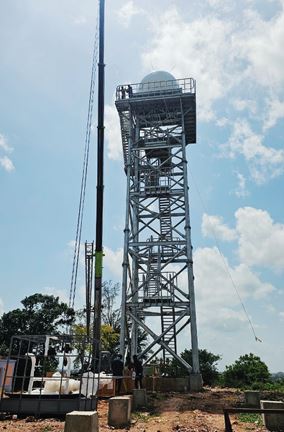
North Karnataka is set to get a major boost to its weather monitoring capabilities with the region’s first dedicated X band Doppler Weather Radar (DWR) being in stalled at the University of Agricultural Sciences (UAS), Dharwad. The radar, coming up at the North Karnataka Agrometeorological Forecasting and Research Centre on the UAS campus, is expected to be operational before October. It will provide real-time information on rain-bearing clouds and developing weather systems within a radius of about 150 km.
Around 65 to 70 per cent of the installation work has been completed, with the main observation tower erected and the core radar equip ment brought to the site. Bharat Electronics Limited (BEL) is carrying out the installation and technical integration. The remaining work includes setting up a dedicated control and analytical facility where scientists will receive, process, and interpret radar data in real time. Unlike conventional weather forecasts that provide information for the coming days, a Doppler weather radar is primarily useful for short term and very short-term forecasting, known as nowcasting.
The radar sends electromagnetic waves into the atmosphere. When the waves encounter raindrops, hail, or other particles in clouds, part of the signal is reflected back. Scientists analyse the returned signals to determine the location and intensity of precipitation and track the movement of weather systems. The Doppler technology also enables the radar to estimate the speed and direction of cloud and precipitation movement. This can help scientists determine whether a rain-bearing system is approaching a particular area and whether it is strengthening or weakening.
Dr.Guna.M, Project Scientist-II, North Karnataka Agrometeoro logical Forecasting and Research Centre, India Meteorological Department, Dharwad. said the radar would be particularly useful for providing information on localised severe weather and supporting alerts to district administrations. The system is expected to strengthen nowcast ing in the six-to-12-hour window, helping district disaster management authorities and collectors take precautionary measures when severe weather develops within the radar’s coverage area.
The radar is expected to be particularly useful for agriculture, where weather conditions can influence decisions within a matter of hours. Timely information on approaching rainfall could help farmers decide when to harvest crops, apply pesticides and fertilisers, or under take sowing operations. It could also help reduce post-harvest losses caused by sudden rain fall. Weather expert R.H. Patil said farmers are of ten affected by untimely, excessive or inadequate rainfall despite the availability of long-range forecasts. “Radars help us to know short-term, very short-term rainfall activity,” he said, highlighting the importance of the technology for farmers.
The radar is also expected to strengthen the response of district administrations to sudden and localised weather events. The radar will not replace satellite observations or numerical weather prediction models, which remain important for medium- and long range forecasts. Instead, it will complement them by providing a more detailed picture of weather systems that are already developing. At present, North Karnataka largely depends on radar observations from neighbouring Goa. The installation at Dharwad is expected to provide more localised weather information by bringing the radar much closer to the weather systems affecting the region.
The project has taken some time because of the infrastructure re quired at the elevated site, including road connectivity and utility facilities. With the main tower and radar equipment in place, the project has entered its final phase. Part of six-radar net work The Dharwad installation is part of a broader plan to strengthen Karnataka’s weather monitoring network with six C-band and X-band Doppler weather radars. Future installations are planned in northern districts; to recall, Union Minister Pralhad Joshi had requested that the then Minister of Science and Technology, Dr. Jitendra Singh, establish such a facility, and the government agreed and started the work.

.jpg)
.jpg)