.jpg)


.jpg)

 English daily published in Bengaluru & Doha

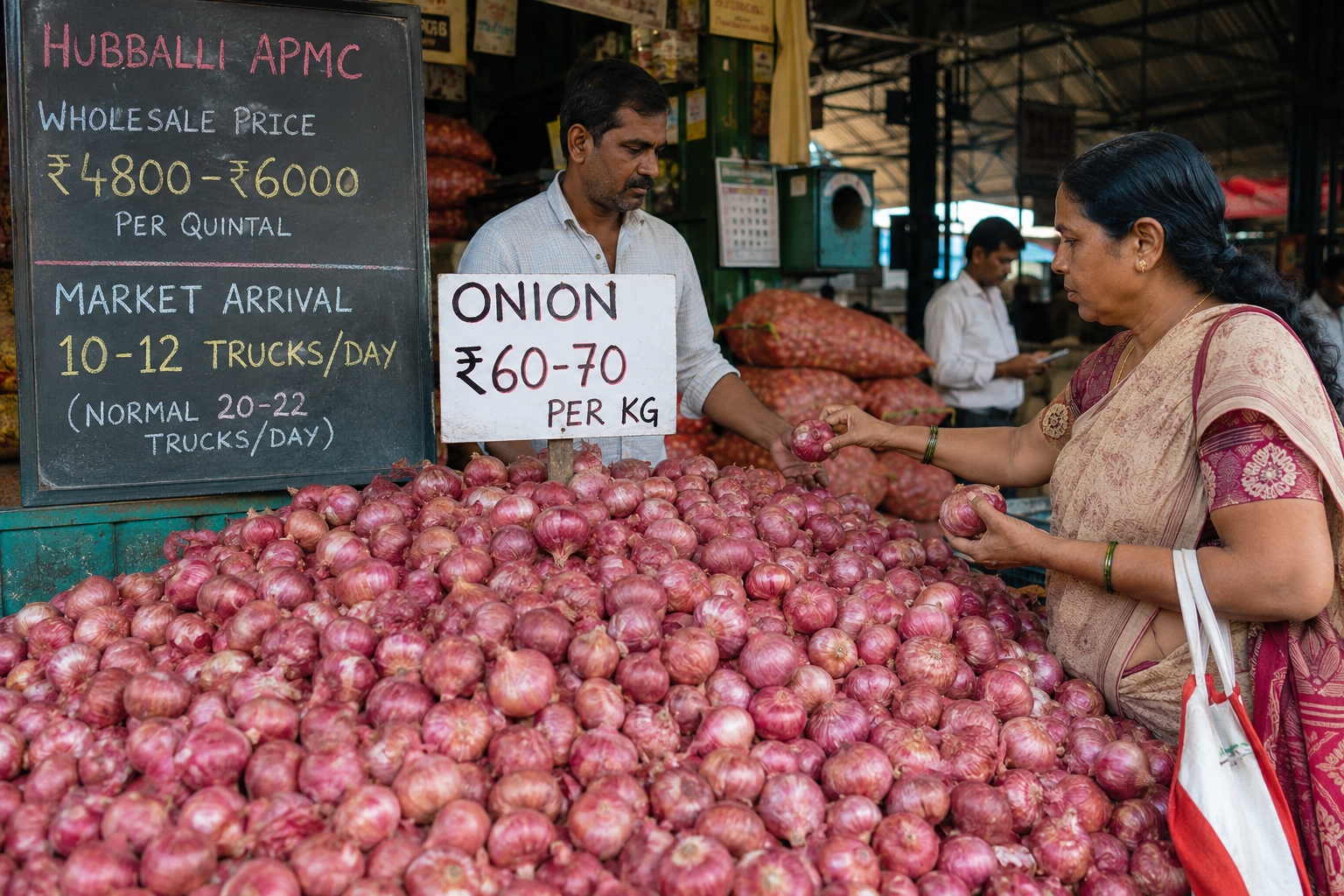
Festivals turn dearer as onion, sugar prices soar
Onion prices in Hubballi have shot up sharply in just 10 days, rising from Rs 20–25 per kg to Rs 60–70 per kg amid a steep decline in local production and reduced arrivals at the market. The price surge comes at a time when demand for onions has increased due to the ongoing Shra vana month and a series of festivals, weddings and other functions. With the local harvest yet to arrive, traders are increasingly relying on old stocks from Maharashtra, pushing up procurement costs. At the Hubballi APMC, wholesale onion prices are currently ranging between Rs 4,800 and Rs 6,000 per quintal, while retail prices have touched Rs 70 per kg. Market arrivals have also declined significantly.
The APMC, which normally receives around 20–22 truckloads of onions a day, is currently receiving only 10–12 trucks, according to traders. Around 60% of the on ions currently reaching the Hubballi market are reportedly from old stocks in Maharashtra. However, supply from Maharashtra has also been affected by adverse weather condi tions, with excess rainfall causing crop damage and rotting in several ar eas. Traders said Hubballi continues to receive supplies as buyers are offering slightly higher prices to procure onions from Maharashtra. The situation has also affected consumers, particularly those purchasing onions in bulk for weddings and festive functions.
Traders said customers who would normally buy entire sacks are now restricting their purchases to around five kg at a time because of the steep increase in prices. Speaking to News Trail, Hubballi APMC Secretary Guruprasad said all the onions currently arriving at the APMC were being sourced from Maharashtra, particularly from stored stocks. He said onion prices normally tend to rise during this period as it is not the harvesting season for locally grown onions. “Since local onions are not being harvested at present, onions from stored stocks in Maharashtra are reaching the market here. Prices may decline in October once locally harvested onions start arriving. At present, the supply is sufficient to meet demand, and there is no shortage,” he said.
He added that while a significant decline in prices could not be predicted at this stage, prices could stabilise once local on ions begin arriving in the market. “It is difficult to say whether onion prices will actually come down,” he said. Onion trader Ismail Zamkhanewale said poor rainfall had severely af fected local production, further disrupting the sup ply chain. Local yields had also been poor last year, and the situation had worsened this year due to the prolonged shortage of rainfall. “Whatever produce we are receiving is from old stocks. Some people are taking advantage of the situation,” he said.
Sugar becomes bitter Meanwhile, retail sugar prices have also risen sharply, touching Rs 80 per kg in some regional markets, though prices have now stabilised at around Rs 70 per kg in Hubballi. Vijay Koti, who runs provisional stores in south parts of Hubballi told one month ago, the price of one kilogram of sugar was 54 and last three days ago it was Rs 80 per kilo, now we are selling retail at 76 and wholesale Rs 70 per kg. The increase in price has triggered concerns among consumers amid reports of poor monsoon rainfall in key sugarcane growing regions and speculation in the market.
Agriculture expert Dr R.H. Patil told News Trail that the primary reason for the tightening of sugar supply was the significant rainfall deficit in Karnataka and parts of Maharashtra. Sugarcane, a water-in tensive crop that requires regular irrigation, has come under severe stress in rain-dependent areas. Dr Patil said overall sugar cane yields could decline by 30–35% this season due to depleted water sources and deficient rainfall. Sugar mills are expect ed to begin crushing op erations between late October and November, but the availability of cane for crushing is likely to be sig- nificantly lower this season, he said. Dr Patil said the crop situation varied consider ably across regions.
While canal-irrigated areas have largely maintained normal standing crops, rain-fed regions have suffered widespread dam age due to inadequate rainfall. Trade analysts, however, have dismissed speculation that the increase in sugar prices is primarily linked to the diversion of sugarcane juice towards the national ethanol blending programme. According to industry sources, the government has largely methanol requirements by using sur plus and aged rice stocks from Food Corporation of India (FCI) warehouses at subsidised rates. An industry expert, who requested anonymity, said the recent rise in retail sugar prices was largely driven by market specula tion. With cane availability expected to tighten, some sugar mills were using scarcity concerns to in crease margins and off set operational losses, the expert said.

.jpg)

.jpg)