.jpg)


.jpg)

 English daily published in Bengaluru & Doha

Monti Fest: Where flowers, faith & 1st harvest meet
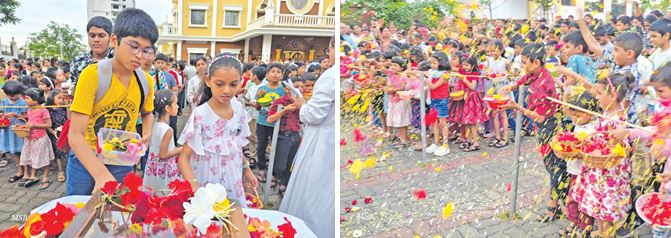
As Mangalorean Catholics prepare for September 8, the celebration brings together prayer, family, children, the harvest and a renewed call to care for creation. As September 8 draws near, homes and churches across the Mangalorean Catholic community begin preparing for one of the region's most cherished celebrations, Monti Fest, the Feast of the Nativity of the Blessed Virgin Mary. For nine days, children arrive at churches carrying co lourful flowers. Families gather for prayer. Hymns fill parish churches.
Before the statue of the infant Mary, the flowers are offered one by one. What may appear to be a simple childhood ritual carries a deeper meaning, an expression of love, gratitude and faith, with children playing a central role in the celebration. At the heart of Monti Fest lies Monte Mariano, or Mount of Mary at Farangipet near Mangaluru, traditionally regarded as the birthplace of the celebration. The historic chapel holds an important place in the Catholic heritage of the region, where devotion to Mary became closely woven into the cultural, agricultural and family life of Mangalorean Catholics.
The nine-day Flower Offering Novena is more than a preparation for the feast. It is a meeting point for generations. Grandparents recall how they celebrated, parents continue the practice, and children be come active participants. Their presence gives the novena a sense of continuity and keeps the celebration meaningful for a new generation.
But the story of Monti Fest does not end at the church.
September 8 has traditionally been a family feast, drawing relatives back to ancestral homes. Families pray together, share a meal and renew bonds that distance and busy lives may have weakened. For many, returning home for Monti Fest is itself an important part of the celebration. The feast is also deeply connected with the new harvest. The first corn of the season is brought to the church, blessed and taken home to be shared. The corn represents gratitude for the earth's abundance and respect for the farmers whose labour makes the harvest possible.
Flowers and corn therefore tell one story. The flowers offered by children symbolise devotion to Mary; the first fruits symbolise thanksgiving for cre- ation. Together, they connect faith, family and the land. A Feast with a Message for Creation Most Rev Peter Paul Saldanha, Bishop of Mangalore Diocese, in his message on Monti Fest, highlighted that September 8 is also observed as Environment Day in the Diocese, urging the faithful to care for nature and to show the utmost respect for creation. The message strikes at the heart of a feast centred on the harvest.
The corn brought for blessing is not merely a symbol of abundance. It is a reminder that every harvest depends on fertile soil, water, favourable seasons and the tireless work of farmers. To give thanks for the harvest, therefore, is also to accept a responsibility to protect the natural world that sustains it. The Bishop's message gives the celebration a contemporary voice: gratitude for creation must lead to care for creation. Respect for nature cannot remain an idea expressed inside the church; it must be reflected in how people use land, water and other resources in everyday life.
Monti Fest is also observed as Girl Child Day, giving the celebration another important dimension. As Catholics celebrate the birth of Mary, the oc- casion becomes a reminder of the dignity, value and potential of every girl child. It calls families and society to nurture chil dren with love, respect, protection and opportunity. Bishop Peter Paul Saldanha, in another significant emphasis, draws attention to the responsibility of protecting precious natural resources. This connects closely with the Pope's intention for the month on saving water.
Water is essential to life, agriculture and every family. Its conservation is therefore not simply an environmental concern but a moral responsibility. The blessing of the new harvest consequently acquires a deeper meaning. It reminds people that the gifts of the earth are precious and that today's choices affect tomorrow's generations. Saving water, protecting nature and using resources responsibly become practical expressions of thanksgiving. Monti Fest thus speaks on several levels at once.
It is a celebration of Mary's Nativity, a gathering of families, a joyful experience for children and a thanksgiving for the harvest. At the same time, through the Bishop's message, it becomes an invitation to look beyond the celebration and ask how faith can shape the way people care for creation and one another. From Monte Mariano at Farangipet to churches and homes across the region, the September 8 celebration continues to bring people to gether. Flowers speak of faith. The harvest speaks of gratitude. The family speaks of be longing. And care for creation speaks of responsibility. Together, they make Monti Fest more than a feast on the calendar. They make it a living expression of faith, family, culture, gratitude and hope for the future.
.jpg)
.jpg)