.jpg)


.jpg)

 English daily published in Bengaluru & Doha

Five corporations, no solutions: GBA turns one
Bengaluru
Bumpy roads and lost lives: Greater Bengaluru Authority marks a grim first anniversary
Persistent water logging, rampant potholes and fatal road accidents continue to plague the city as the Greater Bengaluru Authority marks its first an niversary on Sep 2, after replacing the Bruhat Bengaluru Mahanagara Palike. The restructuring had initially drawn opposition from several experts and citizens, who questioned whether a new adminis trative framework could address Bengaluru’s deep rooted civic challenges. At the same time, many residents had hoped the GBA would usher in a more efficient, responsive and accountable system of governance. Envisioned as a new chapter in the city’s governance, the continuation of civic woes has raised questions over whether the GBA has delivered the promised change and who should be held accountable for the civic failures.
Unnecessary transition
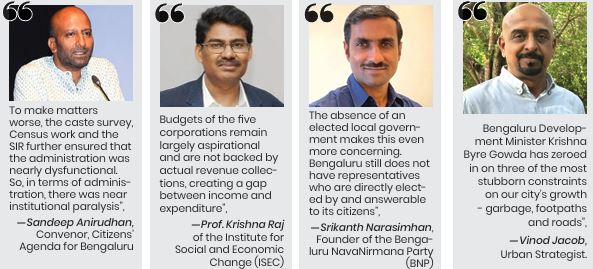
“The GBA formation exercise has been an expensive and unnecessary drain on the city’s time and resources. Apart from the constitutionality of the decision, which is being challenged through at least four PILs in the High Court, the rushed transition created so much confusion that most departments are yet to recover. It took months to assign officials and establish clarity on the administrative framework”, said Sandeep Anirudhan, Convenor, Citizens’ Agenda for Bengaluru. He said the subsequent ward delimitation exercise added to the confusion and further stalled administration, with officials not being assigned to wards for months, bringing even routine civic work to a standstill. “To make mat ters worse, the caste survey, Census work and the SIR further ensured that the administration was nearly dysfunctional.
So, in terms of administration, there was near institutional paralysis”, he said. According to him, the new system has achieved little beyond what the earlier arrangement of Zonal Commissioners had already envisaged in terms of decentralisation. “Even now, citizens have to go all the way to the Chief Commissioners for key decisions”, he said. He further alleged that the delay in holding civic elections has continued, with no immediate relief in sight. “It almost feels as though the very reason the GBA was floated was to delay elections”, he said. “All in all, it paralysed the government for nearly a year in a city that already has a huge governance vacuum!”, he said, adding that even the tax reforms, such as B-to-A property conversion, were a dangerous step that could condone illegalities and set a precedent that chips away at the rule of law. Prof. Krishna Raj of the Institute for Social and Economic Change said the budgets of the five corporations remain largely aspirational and are not backed by actual revenue collections, creating a gap between income and expenditure. “So there is always a gap between revenue and expenditure due to this”, he said, adding that beyond the financial constraints, the GBA was still grappling with issues related to ad ministrative positioning. He also described the re cently launched campaign against on-street parking as a positive step, but said it should have been ac companied by adequate alternative parking spaces for the public.
Where is accountability?
Srikanth Narasimhan, Founder of the Bengaluru NavaNirmana Party (BNP), questioned whether replacing the BBMP with the GBA had addressed Beng aluru’s fundamental problem of accountability. “We continue to see unsafe roads, open drains, flooding, poor infrastructure and other civic failures. More worryingly, citizens continue to lose their lives because of failures that should have been prevented. The question I keep coming back to is simple: when a civic failure causes harm or even takes a life, who is held accountable?”, he asked. Narasimhan said creating a new administrative structure does not automatically establish accountability, arguing that citizens need to know who is responsible for maintaining a road, drain, footpath or executing a project, and who will answer when that responsibility is not fulfilled. “The absence of an elected local government makes this even more concerning. Bengaluru still does not have representatives who are directly elected by and answer able to its citizens”, he said. He noted he will not judge the civic body by the number of authorities, departments or new systems it has created, but by tangible outcomes. “Are our citizens safer? Are civic services better? Are public funds being used effectively?” he emphasised it should be the priority.
Minimal improvements
Urban Strategist Vinod Jacob, however, said the city had witnessed a clearer direction of travel since Krishna Byre Gowda took charge as Bengaluru Development Minister, even if a dramatic transformation was yet to be visible. “He has zeroed in on three of the most stubborn constraints on our city’s growth - garbage, footpaths and roads”, he said.
.jpg)




.jpg)