.jpg)


.jpg)

 English daily published in Bengaluru & Doha

Air quality worsens as firecracker curbs remain on paper
NT Correspondent
Bengaluru: Ahead of Diwali, the Karnataka State Pollution Control Board (KSPCB) issued a circular addressing all the district officers regarding the use of firecrackers. As per the Supreme Court order, only green crackers are to be sold and used and they can be used only from 8 pm to 10 pm.
Authorities have been asked to record sound and air pollution in all districts a week prior to the festivals. They have also been asked to regulate the sound and air pollution throughout the city by taking measures and enforcing the rules on the public.
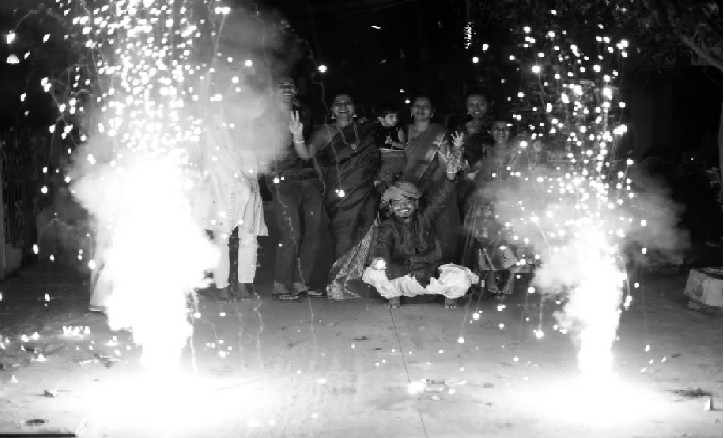
However, people in the city still violated the rules. Tanuja Sinha, a resident in Ejipura who bursted crackers, said, “You can’t stop children from bursting crackers. I don’t think burning fire crackers has any major impact on the pollution level. The industries and factories are producing so many harmful gases still the government allows them so how come they have a problem with small crackers.”
The current air quality index of Bangalore is 59 AQI which is moderate and the PM2.5 rate is 35(µg/m³) which exceeds the threshold concentration by 2.3 times of the World Health Organisation (WHO) which recommends 15 µg/m³.
As per Air Quality Index reports, Bapuji Nagar, BTM Layout, BWSSB Kadubeesanahalli, City Railway Station, Hebbal, Hombegowda Nagar, Jayanagar 5th block, Peenya, Saneguravahalli, Silk Board, SIPCOT, Venkatarchary Nagar and Vijay Nagar share the poorest air quality index while ARK Serene County, Krishnarajapura remain the two areas with a good air quality index.
The rest of the areas such as Bommanhalli, Brookefield, Chansandra, Chinnapanhalli, Cox TTown, CV Raman Nagar, Ejipura, Isro Layout, Koramangala, and Maruthi Nagar report a moderate air quality index.
According to the Greenpeace Southeast Asia report, Bengaluru had also recorded 12,000 avoidable deaths due to air pollution in 2020. According to a report by Greenpeace India, Bengaluru's pollution level is seven times more than WHO standards, even though most things were shut down during the COVID pandemic lockdown.
The study suggested that Bengaluru's air pollution level fell from 40 micrograms per cubic meter of air in 2019 to 30 micrograms per cubic meter of air in November 2021.




.jpg)
