.jpg)


.jpg)

 English daily published in Bengaluru & Doha

Experts call for policy overhaul to safeguard India’s watersheds
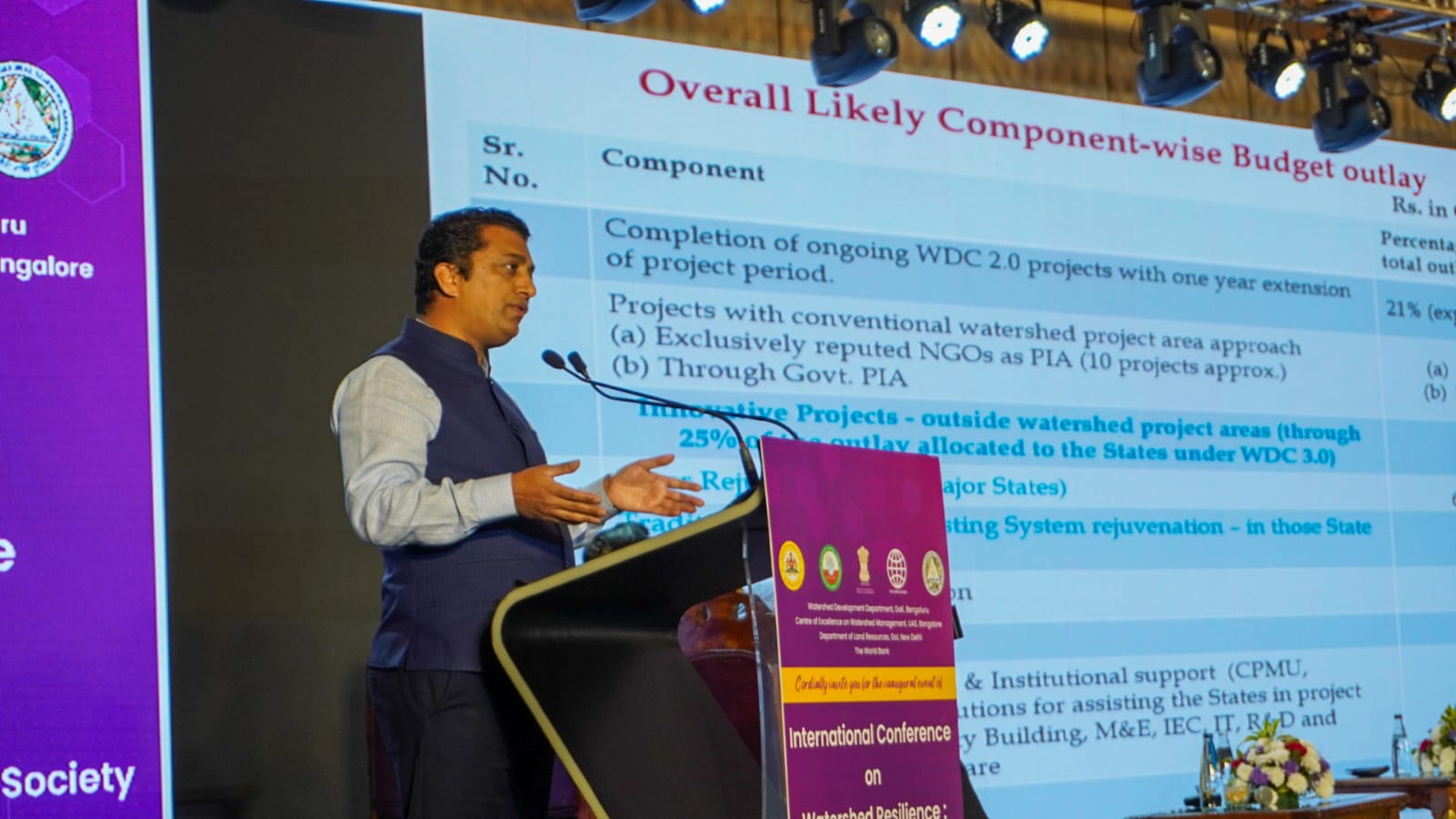
Bengaluru: The first day of the International Conference on Watershed Resilience in Bengaluru highlighted the urgent need to update policies to sustainably manage the country’s water resources.
Andrew Goodland, Lead Agriculture Specialist at the World Bank, speaking during a panel discussion with government officials and field experts, stressed that India must reform its agricultural policy frame work as several sustainability issues remain unaddressed.
“One of the elephants in the room is the policy framework that governs agri-food systems in India. When we examine the root causes of soil degradation, over-extraction of water and the resulting deterioration of water sheds, it is clear these are outcomes of a framework that was successful in ensuring food security but is now running into ecological limits,” he said.
Goodland flagged soil degradation, falling water levels and deteriorating watersheds as key challenges the current policies fail to prevent. Citing China as an example of strong political support for sustainable farming, he said, “We need leadership to truly buy into this and push it forward.
China’s system cannot be replicated in India, but we need elements of that long-term vision.” He added that subsidies should be redesigned to incentivise sustainable agricultural practices that benefit both soil and water.
Government officials at the session also discussed moving programmes such as the Watershed Development Component (WDC) towards more innovative approaches, including the use of Land Resource Inventory (LRI) data.
“Karnataka already has extensive LRI coverage. If no watershed project has been implemented in those areas, we can bring them under WDC 3. We can identify similar high-priority areas in other states where LRI is complete and implement watershed projects on a scientific basis,” said Nitin Khade, Joint Secretary in the Department of Land Resources.
Muhammed Junaid, Director of the Watershed Development and Soil Conservation Department, Rajasthan, outlined how the arid state manages its water resources by involving multiple departments and promoting community ownership through cooperatives.
He added that there was significant scope for IT specialists to support planning and intervention. The department also showcased initiatives in Karnataka, including the development of a new LRI geo-portal that provides detailed information on land resources, enabling officials to take data-driven decisions.
The portal offers farm level information on soil, water, land use, weather, socio-economic indicators and more, supporting programmes such as Krishi Bhagya. The day also featured insights from watershed initiatives in China, Congo and Ethiopia, alongside discussions on the use of digital public infrastructure for agriculture in India.
The conference will continue for two more days, with sessions exploring sustainable agriculture, technology and climate resilience in water management.
.jpg)

.jpg)


