.jpg)


.jpg)

 English daily published in Bengaluru & Doha

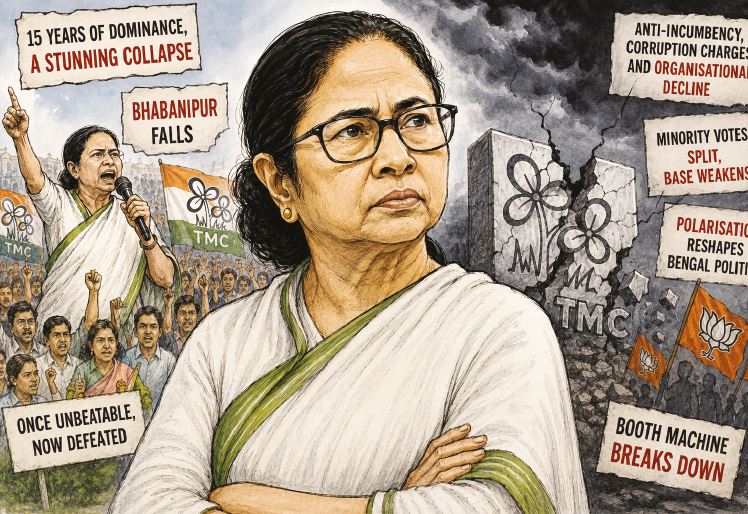
TMC and Mamata: The rise and fall
Kolkata
Mamata Banerjee, the streetfighter who ended the three-decade-long Left Front rule and reshaped West Bengal’s political landscape, has lost not just the state she governed for 15 years, but also Bhabanipur, her political refuge and final fortress. No single factor explains the collapse. Rather, it was a lethal convergence of anti-incumbency, corruption allegations, organisational decline, polarisation politics and the erosion of key voter bases – a tide even the formidable Mamata could not reverse.
The verdict has raised troubling questions about Bengal’s secular political identity. The BJP’s aggressive campaign centred on Hindu consolidation, identity politics, and allegations of Bangladeshi infiltration appears to have significantly altered the state’s electoral landscape. For decades, Bengal’s politics largely revolved around ideology, governance and welfare. This election, however, witnessed an unprecedented consolidation of Hindu voters in several regions, aided by sharp polarising rhetoric, hate speeches and sustained ideological mobilisation by the saffron camp.
The BJP’s narrative appears to have resonated beyond its traditional support base, with even sections of Bengal’s secular electorate succumbing to the pressures of polarisation. Allegations by the TMC and opposition leaders regarding electoral malpractices involving the Election Commission of India (ECI), central agencies and the heavy deployment of paramilitary forces remain politically contentious. However, no conclusive evidence has emerged to substantiate those claims.
Minority vote split and anti-incumbency weaken TMC bastions
The TMC was also battling visible anti-incumbency. The Saradha and Narada scams, recruitment controversies, corruption allegations, administrative fatigue and a sharper opposition narrative had steadily chipped away at the credibility of a party once viewed as electorally invincible. Contrary to widespread pre-poll expectations that the Special Intensive Revision (SIR) of electoral rolls, marked by large-scale deletions, would consolidate Muslim voters behind the TMC, the outcome suggested the opposite. Instead of tactical unity, minority votes fragmented across multiple opposition formations, weakening the TMC in several closely contested constituencies.
The SIR exercise has now emerged as a major subtext of the election. Murshidabad, where Muslims constitute over 66 per cent of the population, illustrates the scale of the shift. In 2021, the TMC won 20 of the district’s 22 Assembly seats. This time, the party has been reduced to just nine. The TMC’s electoral model depended heavily on the near-total consolidation of minority votes. Even a 10–15 per cent shift in key constituencies proved enough to alter outcomes dramatically.
The five districts of Murshidabad, Malda, Uttar Dinajpur, South 24 Parganas and Birbhum together account for 85 Assembly seats, making them decisive in any statewide contest. For the TMC, the verdict signals that its most dependable social coalition is no longer intact. Women voters, who had strongly backed the TMC in 2021, also appear to have shifted in significant numbers towards the BJP. While welfare schemes and financial incentives remain relevant, they may no longer be sufficient to retain loyalty among Bengal’s women voters.
Collapse of party machinery leaves Mamata isolated
Beyond electoral arithmetic, the verdict points to a deeper institutional crisis within the TMC. The party’s once-formidable organisational structure appears to have weakened considerably over the years. Leaders such as Mukul Roy, Suvendu Adhikari and Partha Chatterjee were key organisational architects who built networks, managed local equations and ensured booth-level electoral delivery for the TMC. Some exited at crucial moments, others became politically weakened by controversies, while several gradually lost influence within an increasingly centralised structure revolving around Mamata Banerjee and Abhishek Banerjee.
The result was a dramatic reversal. The TMC, once celebrated for its booth management and grassroots machinery, struggled to match the organisational discipline and electoral preparedness of its rival. Compounding the crisis was the RSS’s decades-long social engineering project in Bengal. Through sustained ideological mobilisation and grassroots outreach, the saffron ecosystem succeeded in consolidating large sections of Hindu voters for the first time in Bengal’s modern political history.

.jpg)
.jpg)
.jpg)