.jpg)


.jpg)

 English daily published in Bengaluru & Doha

Vigilantes run riot as law looks away: Study
NEW DELHI
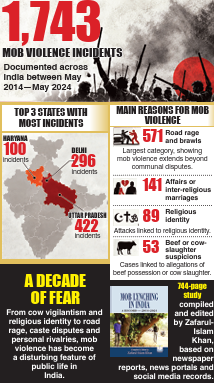
From cow vigilantism and attacks over religious identity to road rage, caste disputes and personal rivalries, mob violence has become a disturbing feature of public life in India, with 1,743 incidents documented between May 2014 and May 2024 in a new study that warns of the growing normalisation of violence outside the law.
Titled 'Mob Lynching in India: A Record — 2014–2024', the 744-page volume has been compiled and edited by journalist and former Delhi Minorities Commission chairman Zafarul-Islam Khan . Drawing on newspaper reports, news portals and social media records, it brings together incidents that might otherwise have faded from public memory.
The study argues that lynching has evolved beyond isolated attacks into a pattern of vigilante violence sustained by impunity, weak enforcement and, in some cases, alleged political patronage. It traces the rise of cow vigilantism, with self-appointed groups allegedly acting as enforcers, targeting people over cattle transport, beef consumption and cow slaughter allegations.
From religious hatred to everyday disputes
The findings also expose the wider reach of mob violence. According to News Trail's examination of the study, 571 incidents arose from road rage and brawls, 89 were linked to religious identity and 53 involved suspicions of beef possession or cow slaughter. Another 141 cases were linked to affairs or inter-religious marriages.
Uttar Pradesh recorded 422 incidents, followed by Delhi with 296 and Haryana with 100. The report also documents attacks on Dalits, including cases involving caste humiliation and violence over everyday acts. While the overall tally includes victims from different communities and disputes, the study argues that religious-hatred-driven attacks have disproportionately targeted Muslims, with Christians also among the victims.
It describes how Muslim men have been attacked over visible markers of identity, including beards and skullcaps, and forced to chant religious slogans. The study further raises concerns about attackers recording assaults and circulating videos on social media, suggesting that the violence serves not only to punish victims but also to intimidate wider communities.
It alleges that weak police responses, compromised investigations and the failure to secure convictions have deepened the climate of fear. The authors acknowledge that the 1,743 incidents represent a conservative compilation, not a comprehensive national census. The study calls for a dedicated anti-lynching law, prompt investigations and prosecutions, compensation and legal aid for victims, and systematic publication of hate-crime data.
Its central warning is that when mobs assume the roles of investigator, judge and executioner, and accountability fails to follow, the damage extends beyond individual victims to the rule of law itself.

.jpg)
.jpg)
.jpg)